Utilization of Virtual Reality: Transforming Spiritual Experiences in Hajj Ritual Learning in High Schools and Tour Travel

https://doi.org/10.51574/ijrer.v5i1.4609
Keywords:
Hajj Rituals, High Schools, Islamic Religious Education, Spiritual Experience, Virtual RealityAbstract
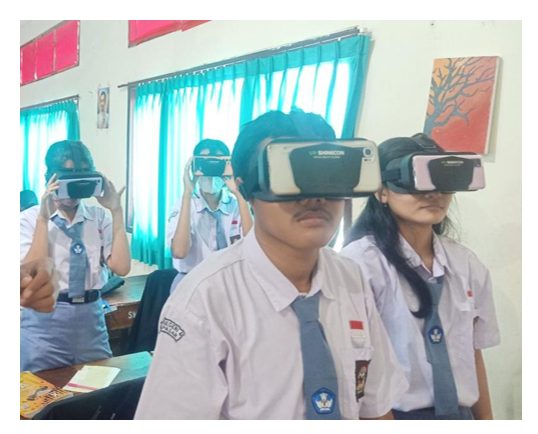
Secondary hajj education is often abstract and limited to physical simulations that cannot capture the Holy Land's vastness and holiness. The lack of representative Islamic religious education laboratories in Wajo Regency exacerbates this. Viewing rituals as physical procedures without inner transformation or Mecca and Medina spatial awareness lowers student spiritual engagement. This study examines how VR technology and PT Darmawan Tour & Travel can improve Wajo Regency high school students' Hajj practices and how digital immersion connects cognitive theory and affective-spiritual experiences. This study employs descriptive qualitative and collaborative case study methods. The study utilized VR devices and PT Darmawan Tour & Travel content in Wajo Regency high schools. Data is collected through participatory observation during VR simulations, in-depth interviews with professors of Islamic Religious Education and Hajj and focus group discussions (FGDs) with students. To measure spiritual presence, data reduction, presentation, and verification were done. The research indicated that VR's "real presence" effect on Hajj rituals evoked high emotional responses, such as emotion and commitment, not found in simulations. PT Darmawan Tour & Travel ensured field-relevant visual and procedural accuracy. Students claimed a better grasp of the pilgrimage itinerary and enhanced religious enthusiasm to perform Hajj. VR can create immersive spiritual places in schools. This paper proposes a VR-based experiential learning methodology for Islamic religious education. This article advocates for a strategic alliance between educational institutions and Hajj travel agencies to enhance religious education resources and urges Wajo Regency education authorities to incorporate immersive technology into the regional curriculum.
References
Alalwan, N., Cheng, L., Al-Samarraie, H., Yousef, R., Alzahrani, A. I., & Sarsam, S. M. (2020). Challenges and prospects of virtual reality and augmented reality utilization among primary school teachers: A developing country perspective. Studies in Educational Evaluation, 66, 100876. https://doi.org/10.1016/j.stueduc.2020.100876
Albus, P., Vogt, A., & Seufert, T. (2021). Signaling in virtual reality influences learning outcome and cognitive load. Computers & Education, 166, 104154. https://doi.org/10.1016/j.compedu.2021.104154
Alshaer, A. (2025). The role of sensory experiences in evoking emotional responses in virtual reality. Journal of Umm Al-Qura University for Engineering and Architecture, 16(1), 172-184. https://doi.org/10.1007/s43995-025-00099-z
Alzeer, A. H., & Abuzinadah, J. (2024). Beyond borders: Exploring the mental, emotional, and spiritual significance of Hajj. Annals of Thoracic Medicine, 19(3), 179-189. https://doi.org/10.4103/atm.atm_72_24
Aryati, A., Jamrizal, J., Anwar, K., Zulkarnain, Z., & Firman, A. J. (2024). Spiritual Pilgrimage Through Virtual Reality (VR): Transforming Islamic Religious Education in Madrasahs. Ta'dib, 27(2), 435-445.
Asril, Z., Syafril, S., Engkizar, E., & Arifin, Z. (2023). Advancing educational practices: Implementation and impact of virtual reality in islamic religious education. Jurnal Pendidikan Islam, 9(2), 199-210. https://doi.org/10.15575/jpi.v9i2.20567
Bhowmik, A. K. (2024). Virtual and augmented reality: Human sensory‐perceptual requirements and trends for immersive spatial computing experiences. Journal of the Society for Information Display, 32(8), 605-646. https://doi.org/10.1002/jsid.2001
Calvert, J., & Hume, M. (2023). Improving student learning outcomes using narrative virtual reality as pre-training. Virtual Reality, 27(3), 2633-2648. https://doi.org/10.1007/s10055-023-00830-y
Crofton, E. C., Botinestean, C., Fenelon, M., & Gallagher, E. (2019). Potential applications for virtual and augmented reality technologies in sensory science. Innovative Food Science & Emerging Technologies, 56, 102178. https://doi.org/10.1016/j.ifset.2019.102178
Hajar, A. (2024). Navigating Globalization: Reforming Islamic Education for the 21st Century. Sinergi International Journal of Islamic Studies, 2(1), 53-65. https://doi.org/10.61194/ijis.v2i1.599
Haryana, M. R. A., Warsono, S., Achjari, D., & Nahartyo, E. (2022). Virtual reality learning media with innovative learning materials to enhance individual learning outcomes based on cognitive load theory. The International Journal of Management Education, 20(3), 100657. https://doi.org/10.1016/j.ijme.2022.100657
Ilyasin, M., & Julaiha, S. (2025). Transformation of Islamic Educational Institution Curriculum to Improve Learning Outcomes in Facing the Challenges of Industrial Society. International Journal of Learning Reformation in Elementary Education, 4(02), 207-225. https://doi.org/10.56741/ijlree.v4i02.1005
Kalender, Y., & Tari Kasnakoglu, B. (2022). Understanding Hajj travel: a dynamic identity perspective. Journal of Tourism and Cultural Change, 20(4), 565-582. https://doi.org/10.1080/14766825.2021.1953046
Kusban, H., Qomariyah, S., Abdurohman, A., & Hermawan, R. (2025). Studi Kritis Bahan Ajar Mata Pelajaran Haji dan Umrah Kelas IX SMP PGRI Bencoy Kec. Cireunghas Sukabumi. Hikmah: Jurnal Studi Pendidikan Agama Islam, 2(3), 70-82. https://doi.org/10.61132/hikmah.v2i3.1296
Latuapo, A. (2021). the Educative Values of Hajj: Implementing the Educative Values of Hajj Into the School Curriculum. Erudio Journal of Educational Innovation, 8(2), 209-221.
Laurens-Arredondo, L. A., & Laurens, L. (2023). Metaversity: Beyond emerging educational technology. Sustainability, 15(22), 15844. https://doi.org/10.3390/su152215844
Lehane, L. (2025). Experiential Learning—David A. Kolb. In Science education in theory and practice: An introductory guide to learning theory (pp. 235-253). Cham: Springer Nature Switzerland. https://doi.org/10.1007/978-3-031-81351-1_14
Mills, K. A., & Brown, A. (2022). Immersive virtual reality (VR) for digital media making: transmediation is key. Learning, Media and Technology, 47(2), 179-200. https://doi.org/10.1080/17439884.2021.1952428
Müller, S., Dekker, E., Morris-Binelli, K., Piggott, B., Hoyne, G., Christensen, W., ... & Hambrick, D. Z. (2023). Attributes of expert anticipation should inform the design of virtual reality simulators to accelerate learning and transfer of skill. Sports Medicine, 53(2), 301-309. https://doi.org/10.1007/s40279-022-01735-7
Passarelli, A. M., & Kolb, D. A. (2023). Using experiential learning theory to promote student learning and development in programs of education abroad. In Student learning abroad (pp. 137-161). Routledge. https://doi.org/10.4324/9781003447184-8
Queiroz, A. C. M., Fauville, G., Herrera, F., Leme, M. I. D. S., & Bailenson, J. N. (2022). Do students learn better with immersive virtual reality videos than conventional videos? A comparison of media effects with middle school girls. Technology, Mind, and Behavior, 3(3), 468. https://doi.org/10.1037/tmb0000082
Radhakrishnan, U., Chinello, F., & Koumaditis, K. (2023). Investigating the effectiveness of immersive VR skill training and its link to physiological arousal. Virtual reality, 27(2), 1091-1115. https://doi.org/10.1007/s10055-022-00699-3
Rahman, Y. A., Hasan, I., Wage, W., & Sriyanto, S. (2024). Analisis Model Contextual Teaching and Learning (CTL) dalam Pembelajaran Materi Haji: Pendekatan Filosofis. Instructional Development Journal, 7(2), 447-457. http://dx.doi.org/10.24014/idj.v7i2.31387
Ramadhan, M., Hasanah, S. M., Khoirunnisa, T., Sampurno, T. A. M., Faizin, N., Sultoni, A., ... & bin Rekan, A. A. (2025). Building Virtual Reality Hajj Journey Learning Media as a Simulation Tool for Teaching Hajj and Umrah Topics. Nadwa: Jurnal Pendidikan Islam, 19(1), 39-64. https://doi.org/10.21580/nw.2025.19.1.26704
Reale, G., Fusco, A., Calciano, R., Vallario, N., Vagnarelli, G., Caliandro, P., ... & Padua, L. (2023). The immediate effects of immersive virtual reality on autonomic nervous system function in patients with disorders of consciousness after severe acquired brain injury: a pilot study. Journal of Clinical Medicine, 12(24), 7639. https://doi.org/10.3390/jcm12247639
Sudiro, S., & Munjin, M. (2024). Teaching Management of Islamic Religion Education Based on Virtual Reality at Junior High School. AL-ISHLAH: Jurnal Pendidikan, 16(4), 4599-4612. http://journal.staihubbulwathan.id/index.php/alishlah/article/view/6183
Villena-Taranilla, R., Tirado-Olivares, S., Cózar-Gutiérrez, R., & González-Calero, J. A. (2022). Effects of virtual reality on learning outcomes in K-6 education: A meta-analysis. Educational Research Review, 35, 100434. https://doi.org/10.1016/j.edurev.2022.100434
Wijnen-Meijer, M., Brandhuber, T., Schneider, A., & Berberat, P. O. (2022). Implementing Kolb s experiential learning cycle by linking real experience, case-based discussion and simulation. Journal of medical education and curricular development, 9, 23821205221091511. https://doi.org/10.1177/23821205221091511
Wrzus, C., Frenkel, M. O., & Schöne, B. (2024). Current opportunities and challenges of immersive virtual reality for psychological research and application. Acta Psychologica, 249, 104485. https://doi.org/10.1016/j.actpsy.2024.104485
Yu, Z., & Xu, W. (2022). A meta‐analysis and systematic review of the effect of virtual reality technology on users' learning outcomes. Computer applications in engineering education, 30(5), 1470-1484. https://doi.org/10.1002/cae.22532
Downloads
Published
How to Cite
Issue
Section
License
Copyright (c) 2025 Hasan Basri

This work is licensed under a Creative Commons Attribution-ShareAlike 4.0 International License.