Integrasi STEM dalam Modul Pembelajaran Matematika dan Dampaknya terhadap Argumentasi Matematis Siswa

https://doi.org/10.51574/jrip.v6i1.4581
Keywords:
STEM, Modul, Argumentasi MatematisAbstract
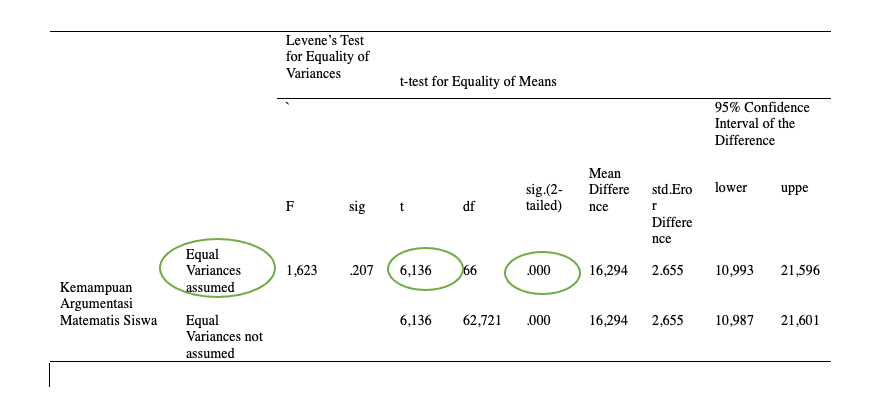
Penelitian ini bertujuan untuk menguji pengaruh penggunaan modul pembelajaran matematika berbasis STEM terhadap kemampuan argumentasi matematis siswa sekolah menengah pertama. Penelitian ini menggunakan pendekatan kuantitatif dengan desain quasi-eksperimental, yaitu posttest only control group design. Subjek penelitian terdiri atas 68 siswa kelas VII MTs Negeri 2 Lombok Tengah yang dibagi ke dalam kelompok eksperimen dan kelompok kontrol melalui teknik purposive sampling. Kelompok eksperimen mengikuti pembelajaran menggunakan modul matematika berbasis STEM, sedangkan kelompok kontrol mengikuti pembelajaran konvensional. Data dikumpulkan menggunakan tes kemampuan argumentasi matematis dan lembar observasi keterlaksanaan pembelajaran. Analisis data dilakukan melalui statistik deskriptif, uji prasyarat (normalitas dan homogenitas), serta uji hipotesis menggunakan independent sample t-test. Hasil analisis menunjukkan adanya perbedaan yang signifikan antara kemampuan argumentasi matematis siswa pada kelompok eksperimen dan kelompok kontrol. Siswa yang belajar menggunakan modul pembelajaran matematika berbasis STEM memiliki kemampuan argumentasi matematis yang lebih tinggi dibandingkan siswa yang mengikuti pembelajaran konvensional. Temuan ini mengindikasikan bahwa pembelajaran matematika yang terintegrasi melalui pendekatan STEM efektif dalam mendorong siswa untuk menyusun argumen matematis yang logis, terstruktur, dan berbasis alasan. Penelitian ini terbatas pada jumlah sampel dan konteks sekolah tertentu. Penelitian selanjutnya disarankan untuk melibatkan sampel yang lebih luas dan desain penelitian yang lebih beragam. Hasil penelitian ini dapat menjadi dasar bagi guru dan sekolah dalam mengembangkan bahan ajar inovatif berbasis STEM untuk meningkatkan kemampuan argumentasi matematis siswa. Penelitian ini memberikan bukti empiris mengenai efektivitas modul pembelajaran matematika berbasis STEM dalam meningkatkan kemampuan argumentasi matematis siswa.
Downloads
References
Becker, K., & Park, K. (2011). Integrative approaches among science, technology, engineering, and mathematics (STEM) subjects on students’ learning: A meta-analysis. Journal of STEM Education: Innovations and Research, 12(5–6), 23–37.
Boero, P., Douek, N., Morselli, F., & Pedemonte, B. (2010). Argumentation and proof: A contribution to theoretical perspectives and their classroom implementation. Educational Studies in Mathematics, 74(2), 185–202. https://doi.org/10.1007/s10649-010-9246-5
Bybee, R. W. (2013). The case for STEM education: Challenges and opportunities. National Science Teachers Association Press.
Capraro, R. M., Capraro, M. M., & Morgan, J. R. (2013). STEM project-based learning: An integrated science, technology, engineering, and mathematics (STEM) approach. Sense Publishers. https://doi.org/10.1007/978-94-6209-143-6
de Jong, T., Linn, M. C., & Zacharia, Z. C. (2014). Physical and virtual laboratories in science and engineering education. Science, 340(6130), 305–308. https://doi.org/10.1126/science.1230579
English, L. D. (2016). STEM education K–12: Perspectives on integration. International Journal of STEM Education, 3(3), 1–8. https://doi.org/10.1186/s40594-016-0036-1
English, L. D. (2023). Advancing STEM education through argumentation and modeling. International Journal of STEM Education, 10(12), 1–15. https://doi.org/10.1186/s40594-023-00395-2
English, L. D., & King, D. (2019). STEM integration in primary education: Challenges and ways forward. Education Sciences, 9(3), 204. https://doi.org/10.3390/educsci9030204
Hanna, G., & de Villiers, M. (2012). Proof and proving in mathematics education. Springer. https://doi.org/10.1007/978-94-007-2129-6
Harel, G., & Sowder, L. (2007). Toward comprehensive perspectives on the learning and teaching of proof. In F. K. Lester Jr. (Ed.), Second handbook of research on mathematics teaching and learning (pp. 805–842). Information Age Publishing.
Inglis, M., Mejía-Ramos, J. P., & Simpson, A. (2007). Modelling mathematical argumentation: The importance of proof. Educational Studies in Mathematics, 66(3), 315–336. https://doi.org/10.1007/s10649-006-9059-2
Kelley, T. R., & Knowles, J. G. (2016). A conceptual framework for integrated STEM education. International Journal of STEM Education, 3(11), 1–11. https://doi.org/10.1186/s40594-016-0046-z
Knipping, C., & Reid, D. (2019). Argumentation in mathematics education: Perspectives and prospects. Mathematical Thinking and Learning, 21(2), 89–101. https://doi.org/10.1080/10986065.2019.1564964
Li, Y., Wang, K., Xiao, Y., & Froyd, J. E. (2020). Research and trends in STEM education: A systematic review of journal publications. International Journal of STEM Education, 7(11), 1–16. https://doi.org/10.1186/s40594-020-00207-6
Lithner, J. (2008). A research framework for creative and imitative reasoning. Educational Studies in Mathematics, 67(3), 255–276. https://doi.org/10.1007/s10649-007-9104-2
Marginson, S., Tytler, R., Freeman, B., & Roberts, K. (2013). STEM: Country comparisons. Australian Council of Learned Academies.
Mercier, H., & Howe, C. (2012). Explaining the argumentative turn in education. Educational Psychology Review, 24(3), 471–491. https://doi.org/10.1007/s10648-012-9199-7
OECD. (2018). The future of education and skills: Education 2030. OECD Publishing.
Osborne, J., Erduran, S., & Simon, S. (2016). Learning to argue scientifically: A research synthesis. Journal of Research in Science Teaching, 53(4), 518–547. https://doi.org/10.1002/tea.21257
Pepin, B., Gueudet, G., & Trouche, L. (2013). Re-sourcing teachers’ work and interactions: A collective perspective on resources, their use and transformation. ZDM Mathematics Education, 45(7), 929–943. https://doi.org/10.1007/s11858-013-0534-2
Remillard, J. T. (2005). Examining key concepts in research on teachers’ use of mathematics curricula. Review of Educational Research, 75(2), 211–246. https://doi.org/10.3102/00346543075002211
Selden, A., & Selden, J. (2003). Validations of proofs considered as texts. Journal for Research in Mathematics Education, 34(1), 4–36. https://doi.org/10.2307/30034754
Shadish, W. R., Cook, T. D., & Campbell, D. T. (2002). Experimental and quasi-experimental designs for generalized causal inference. Houghton Mifflin.
Stein, M. K., Engle, R. A., Smith, M. S., & Hughes, E. K. (2008). Orchestrating productive mathematical discussions. Mathematics Teaching in the Middle School, 14(1), 28–34.
Stylianides, A. J. (2018). The role of reasoning-and-proving in mathematics education. Educational Studies in Mathematics, 98(1), 1–5. https://doi.org/10.1007/s10649-018-9818-9
Stylianides, A. J., & Harel, G. (2018). Advances in mathematics education research on proof and proving. ZDM Mathematics Education, 50(1–2), 1–4. https://doi.org/10.1007/s11858-018-0929-6
Stylianides, A. J., & Stylianides, G. J. (2009). Proof constructions and evaluations. Educational Studies in Mathematics, 72(2), 237–253. https://doi.org/10.1007/s10649-009-9191-3
Stylianou, D. A., Blanton, M. L., & Rotou, O. (2016). Undergraduate students’ understanding of proof. Journal of Mathematical Behavior, 43, 142–162. https://doi.org/10.1016/j.jmathb.2016.06.001
Weber, K., Maher, C., Powell, A., & Lee, H. S. (2020). Learning opportunities from group discussions in mathematics classrooms. Journal for Research in Mathematics Education, 51(2), 199–224. https://doi.org/10.5951/jresematheduc.51.2.0199
Yackel, E., & Hanna, G. (2003). Reasoning and proof. In J. Kilpatrick, W. G. Martin, & D. Schifter (Eds.), A research companion to principles and standards for school mathematics (pp. 227–236). National Council of Teachers of Mathematics.
Downloads
Published
How to Cite
Issue
Section
License
Copyright (c) 2026 Wartini Wartini, Parhaini Andriani, Afifurrahman Afifurrahman

This work is licensed under a Creative Commons Attribution-ShareAlike 4.0 International License.