Development of Mathematics Learning Media on Build Flat Side Space Using Smart Apps Creator

https://doi.org/10.51574/kognitif.v5i4.3247
Keywords:
Learning Media , Smart Apps Creator , Flat- Sided ShapesAbstract
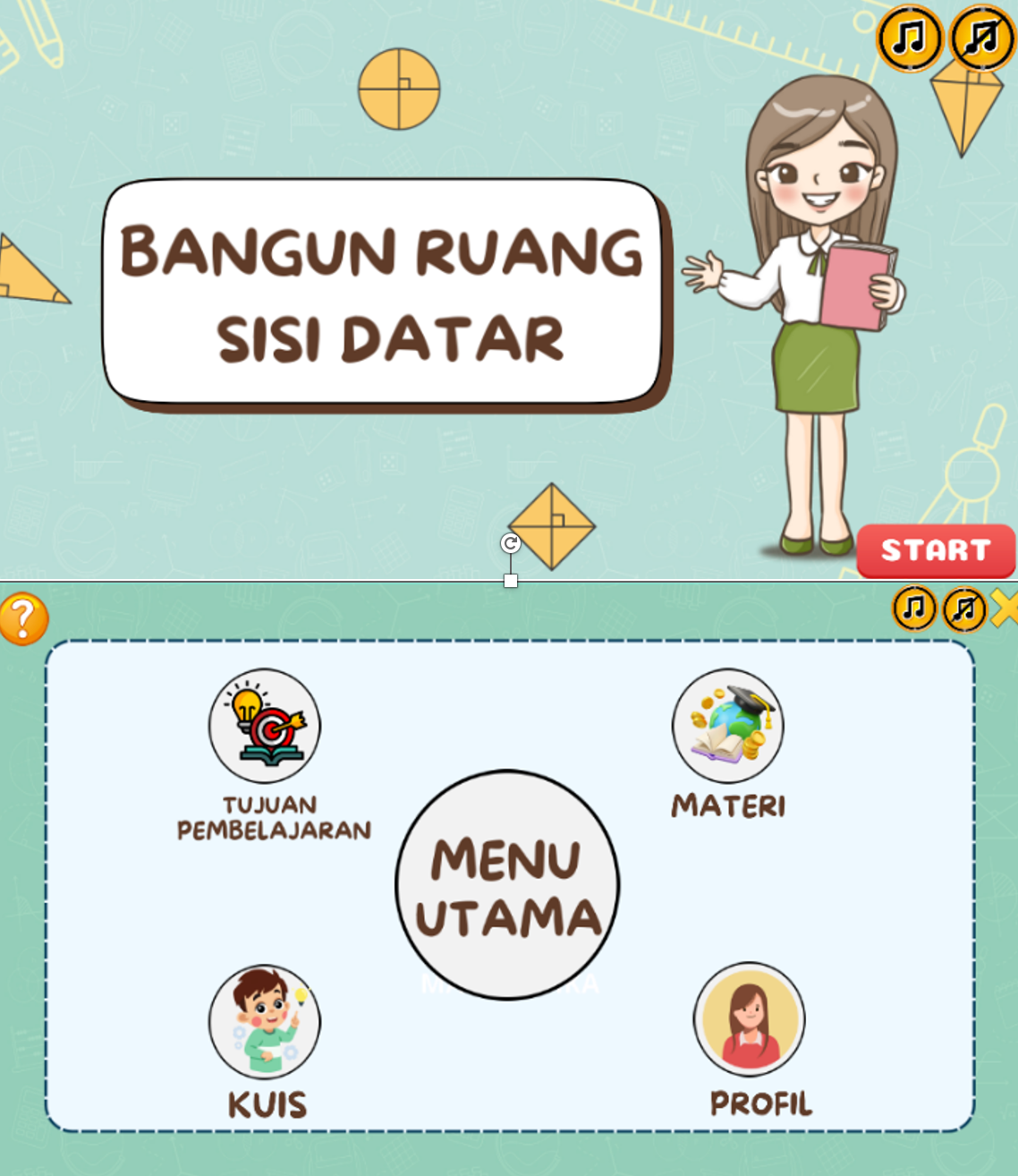
Learning mathematics in the subject of Build Flat-Side Space remains a challenge for junior high school students due to limited visual representation and minimal use of technological media that can facilitate spatial understanding. The abstract nature of shape concepts requires clear visualization, but conventional learning practices tend to rely only on static images in textbooks. This condition has an impact on the low level of concept understanding and learning motivation of students. Smart Apps Creator (SAC) as an interactive media development tool has the potential to provide dynamic visualizations and a more interesting learning experience. This study aims to develop SAC-assisted mathematics learning media and test its validity, practicality, and effectiveness in supporting the learning of flat-sided shapes. The study uses the Research and Development (R&D) method with the ADDIE model, which includes the stages of needs analysis, product design, media development, classroom implementation, and evaluation. The research instruments consisted of expert validation sheets for material and media, student questionnaires, and learning outcome tests. The validation process was carried out to assess the suitability of the content, appearance, and usefulness of the media, while the practicality and effectiveness tests were conducted through the use of media in classroom learning. The results showed that the SAC-based learning media achieved a highly valid rating from experts, was practical based on user responses, and was effective in increasing motivation and understanding of flat-sided spatial concepts. Thus, this media can be used as an alternative interactive learning resource that supports a more interesting, meaningful, and needs-based mathematics learning process for junior high school students.
Downloads
References
Asami-Johansson, Y., Attorps, I., & Winsløw, C. (2020). Comparing mathematics education lessons for primary school teachers: case studies from Japan, Finland and Sweden. International Journal of Mathematical Education in Science and Technology, 51(5), 688–712. https://doi.org/10.1080/0020739X.2019.1614688
Bos, R., Doorman, M., & Piroi, M. (2020). Emergent models in a reinvention activity for learning the slope of a curve. Journal of Mathematical Behavior, 59(July 2019), 100773. https://doi.org/10.1016/j.jmathb.2020.100773
Castro, E., Cañadas, M. C., Molina, M., & Rodríguez-Domingo, S. (2022). Difficulties in semantically congruent translation of verbally and symbolically represented algebraic statements. Educational Studies in Mathematics, 109(3), 593–609. https://doi.org/10.1007/s10649-021-10088-3
Charitas, R., Prahmana, I., Arnal-palacián, M., & Risdiyanti, I. (2023). Trivium curriculum in Ethno-RME approach : An impactful insight from ethnomathematics and realistic mathematics education. Jurnal Elemen, 9(January), 298–316.
David, E. J., Roh, K. H., & Sellers, M. E. (2018). Value-thinking and location-thinking: Two ways students visualize points and think about graphs. Journal of Mathematical Behavior, August, 1–18. https://doi.org/10.1016/j.jmathb.2018.09.004
Fredriksdotter, H., Norén, N., & Bråting, K. (2022). Investigating grade-6 students’ justifications during mathematical problem solving in small group interaction. Journal of Mathematical Behavior, 67(January). https://doi.org/10.1016/j.jmathb.2022.100972
Gasteiger, H., Bruns, J., Benz, C., Brunner, E., & Sprenger, P. (2020). Mathematical pedagogical content knowledge of early childhood teachers: a standardized situation-related measurement approach. ZDM - Mathematics Education, 52(2), 193–205. https://doi.org/10.1007/s11858-019-01103-2
Günster, S. M., & Weigand, H. G. (2020). Designing digital technology tasks for the development of functional thinking. ZDM - Mathematics Education, 52(7), 1259–1274. https://doi.org/10.1007/s11858-020-01179-1
Harris, D., Logan, T., & Lowrie, T. (2023). Spatial visualization and measurement of area: A case study in spatialized mathematics instruction. Journal of Mathematical Behavior, 70(May 2022), 101038. https://doi.org/10.1016/j.jmathb.2023.101038
Hernández, A., Perdomo-Díaz, J., & Camacho-Machín, M. (2020). Mathematical understanding in problem solving with GeoGebra: a case study in initial teacher education. International Journal of Mathematical Education in Science and Technology, 51(2), 208–223. https://doi.org/10.1080/0020739X.2019.1587022
Hsieh, F. J., Wang, T. Y., Hsieh, C. J., & Chu, C. T. (2025). The relationships of preservice teachers’ dispositions and noticing of technology-integrated mathematics teaching activities. ZDM - Mathematics Education. https://doi.org/10.1007/s11858-025-01727-7
Jankvist, U. T., & Niss, M. (2020). Upper secondary school students’ difficulties with mathematical modelling. International Journal of Mathematical Education in Science and Technology, 51(4), 467–496. https://doi.org/10.1080/0020739X.2019.1587530
Jenßen, L., Möller, R., Eilerts, K., & Roesken-Winter, B. (2022). Pre-service primary teachers’ shame experiences during their schooling time: characteristics and effects on their subject-choices at university. Educational Studies in Mathematics, 110(3), 435–455. https://doi.org/10.1007/s10649-021-10141-1
Khozaei, S. A., Zare, N. V., Moneghi, H. K., Sadeghi, T., & Taraghdar, M. M. (2022). Effects of quantum-learning and conventional teaching methods on learning achievement, motivation to learn, and retention among nursing students during critical care nursing education. Smart Learning Environments, 9(1). https://doi.org/10.1186/s40561-022-00198-7
Kosko, K. W. (2020). The multiplicative meaning conveyed by visual representations. Journal of Mathematical Behavior, 60(January), 100800. https://doi.org/10.1016/j.jmathb.2020.100800
Kotsopoulos, D., Zambrzycka, J., & Makosz, S. (2017). Gender Differences in Toddlers’ Visual-Spatial Skills. Mathematical Thinking and Learning, 19(3), 167–180. https://doi.org/10.1080/10986065.2017.1328634
Mentari, W. N., & Syarifuddin, H. (2020). Improving student engagement by mathematics learning based on contextual teaching and learning. Journal of Physics: Conference Series, 1554(1). https://doi.org/10.1088/1742-6596/1554/1/012003
Montenegro, P., Costa, C., & Lopes, B. (2018). Transformations in the Visual Representation of a Figural Pattern. Mathematical Thinking and Learning, 20(2), 91–107. https://doi.org/10.1080/10986065.2018.1441599
Muzaini, M., Rahayuningsih, S., Ikram, M., & Nasiruddin, F. A. Z. (2023). Mathematical Creativity: Student Geometrical Figure Apprehension in Geometry Problem-Solving Using New Auxiliary Elements. International Journal of Educational Methodology, 9(1), 139–150. https://doi.org/10.12973/ijem.9.1.139
Noguez, J., & Neri, L. (2019). Research-based learning: a case study for engineering students. International Journal on Interactive Design and Manufacturing, 13(4). https://doi.org/10.1007/s12008-019-00570-x
Öçal, M. F., Şen, C., Güler, G., & Kar, T. (2020). The investigation of prospective mathematics teachers’ non-algebraic solution strategies for word problems. International Journal of Mathematical Education in Science and Technology, 51(4), 563–584. https://doi.org/10.1080/0020739X.2019.1597936
Olsher, S., Abdu, R., & Shalata, M. (2025). The relationships between student content-specific grouping and teachers-students’ interactions during online collaborative mathematical task solving. Educational Studies in Mathematics, 119(2), 249–268. https://doi.org/10.1007/s10649-024-10382-w
Patahuddin, S. M., Ramful, A., Lowrie, T., & Bholoa, A. (2022). Subtleties in spatial visualization maneuvers: Insights from numerical solutions. Journal of Mathematical Behavior, 67(June 2021), 100988. https://doi.org/10.1016/j.jmathb.2022.100988
Powell, S. R., Berry, K. A., & Benz, S. A. (2020). Analyzing the word-problem performance and strategies of students experiencing mathematics difficulty. Journal of Mathematical Behavior, 58(March 2019), 100759. https://doi.org/10.1016/j.jmathb.2020.100759
Qadry, I. K., Dessa, A., & Aynul, N. (2022). Analisis Kemampuan Literasi Matematika Siswa Dalam Menyelesaikan Soal Pisa Konten Space and Shape Pada Kelas IX SMP Negeri 13 Makassar. Jurnal Matematika Dan Aplikasinya, 2(2).
Ratnayake, I., Thomas, M., & Kensington-Miller, B. (2020). Professional development for digital technology task design by secondary mathematics teachers. ZDM - Mathematics Education, 52(7), 1423–1437. https://doi.org/10.1007/s11858-020-01180-8
Rezat, S., Fan, L., & Pepin, B. (2021). Mathematics textbooks and curriculum resources as instruments for change. ZDM – Mathematics Education, 53(6), 1189–1206. https://doi.org/10.1007/s11858-021-01309-3
Rocha, H. (2020a). Graphical representation of functions using technology: A window to teacher knowledge. Teaching Mathematics and Its Applications, 39(2), 105–126. https://doi.org/10.1093/teamat/hrz011
Rocha, H. (2020b). Using tasks to develop pre-service teachers’ knowledge for teaching mathematics with digital technology. ZDM - Mathematics Education, 52(7), 1381–1396. https://doi.org/10.1007/s11858-020-01195-1
Rodríguez-Muñiz, L. J., Aguilar-González, Á., Lindorff, A., & Muñiz-Rodríguez, L. (2022). Undergraduates’ conceptions of mathematics teaching and learning: an empirical study. Educational Studies in Mathematics, 109(3), 523–547. https://doi.org/10.1007/s10649-021-10105-5
Schulz, A. (2023). Assessing student teachers’ procedural fluency and strategic competence in operating and mathematizing with natural and rational numbers. Journal of Mathematics Teacher Education, 27(6), 981–1008. https://doi.org/10.1007/s10857-023-09590-7
Swidan, O., & Fried, M. (2021). Focuses of awareness in the process of learning the fundamental theorem of calculus with digital technologies. Journal of Mathematical Behavior, 62(June 2020), 100847. https://doi.org/10.1016/j.jmathb.2021.100847
Voigt, M., Fredriksen, H., & Rasmussen, C. (2020). Leveraging the design heuristics of realistic mathematics education and culturally responsive pedagogy to create a richer flipped classroom calculus curriculum. ZDM - Mathematics Education, 52(5), 1051–1062. https://doi.org/10.1007/s11858-019-01124-x
Walkington, C., Nathan, M. J., Hunnicutt, J., Washington, J., & Zhou, M. (2024). New kinds of embodied interactions that arise in augmented reality dynamic geometry software. Journal of Mathematical Behavior, 75(June), 101175. https://doi.org/10.1016/j.jmathb.2024.101175
Yao, X., & Manouchehri, A. (2019). Middle school students’ generalizations about properties of geometric transformations in a dynamic geometry environment. Journal of Mathematical Behavior, 55(September 2018), 1–19. https://doi.org/10.1016/j.jmathb.2019.04.002
Zambak, V. S., & Tyminski, A. M. (2020). Examining mathematical technological knowledge of pre-service middle grades teachers with Geometer’s Sketchpad in a geometry course. International Journal of Mathematical Education in Science and Technology, 51(2), 183–207. https://doi.org/10.1080/0020739X.2019.1650302
Downloads
Published
How to Cite
Issue
Section
License
Copyright (c) 2025 Tesalonika M. Oroh, Murni Sulistyaningsih, Derel F. Kaunang

This work is licensed under a Creative Commons Attribution-ShareAlike 4.0 International License.
Education and Talent Development Center of Indonesia (ETDC Indonesia)
e-mail: kognitif@gmail.com, website : https://etdc-indonesia.com

Kognitif: Jurnal Riset HOTS Pendidikan Matematika dengan Situs: https://etdci.org/journal/kognitif berlisensi Creative Commons Attribution-ShareAlike 4.0 International License







.png)