Analysis of Mathematics Teachers’ Difficulties in Implementing Differentiated Learning under the Independent Curriculum

https://doi.org/10.51574/kognitif.v5i4.3817
Keywords:
Differentiated learning , Mathematics teachers, Teacher difficulties , Independent Curriculum, Qualitative studyAbstract
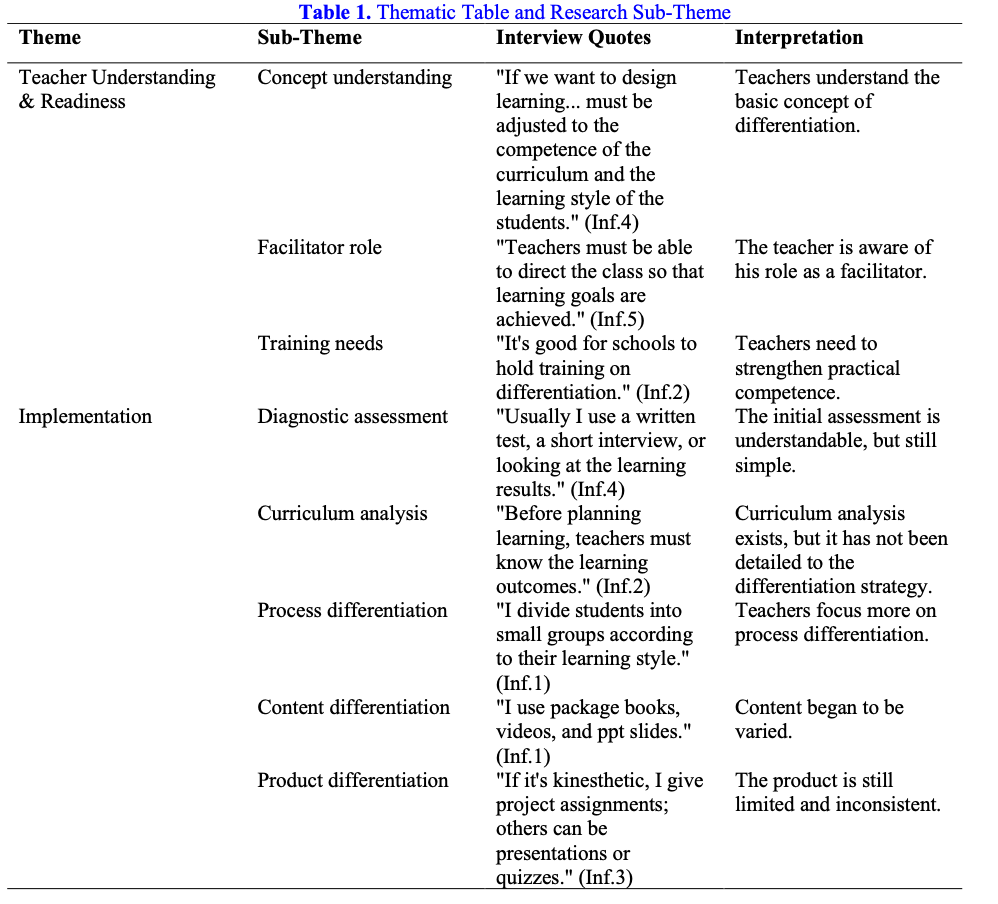
Merdeka Curriculum promotes differentiated learning as a key strategy to address students’ diverse learning needs. However, a preliminary study at SMA Negeri 3 Gunungsitoli indicates that this approach has not been implemented consistently in mathematics classrooms. This study aims to describe how mathematics teachers apply differentiated learning and to analyze the difficulties they face and the factors influencing these difficulties within the Independent Curriculum. This study employed a qualitative descriptive design. Data were collected through interviews, classroom observations, and document analysis involving five mathematics teachers. The data were analyzed using the Miles and Huberman interactive model, including data reduction, data display, and conclusion drawing. The findings show that teachers have begun to implement differentiation in content, process, and product. However, the implementation remains limited. Major difficulties include time management constraints, diverse student learning characteristics, and challenges in conducting initial diagnostic assessments. Contributing factors include limited facilities, insufficient teacher readiness, and a lack of structured professional training. These findings indicate that differentiated learning in mathematics is still at an early stage of implementation and requires systematic institutional support. This study contributes to the literature by highlighting context-specific challenges faced by mathematics teachers under the Independent Curriculum and provides practical implications for schools and policymakers in designing targeted professional development programs.
Downloads
References
Álvarez, J. A. M., Arnold, E. G., Burroughs, E. A., Fulton, E. W., & Kercher, A. (2020). The design of tasks that address applications to teaching secondary mathematics for use in undergraduate mathematics courses. Journal of Mathematical Behavior, 60(September). https://doi.org/10.1016/j.jmathb.2020.100814
Borji, V., & Martínez-Planell, R. (2020). On students’ understanding of implicit differentiation based on APOS theory. Educational Studies in Mathematics, 105(2), 163–179. https://doi.org/10.1007/s10649-020-09991-y
Charitas, R., Prahmana, I., Arnal-palacián, M., & Risdiyanti, I. (2023). Trivium curriculum in Ethno-RME approach : An impactful insight from ethnomathematics and realistic mathematics education. Jurnal Elemen, 9(January), 298–316.
Chorney, S., Evans, K. R., & Staples, M. (2024). Conceptualizing reasoning practices in the context of sociomathematical issues. Journal of Mathematical Behavior, 73. https://doi.org/10.1016/j.jmathb.2024.101124
Copur-Gencturk, Y., & Doleck, T. (2021). Strategic competence for multistep fraction word problems: an overlooked aspect of mathematical knowledge for teaching. Educational Studies in Mathematics, 49–70. https://doi.org/10.1007/s10649-021-10028-1
Csíkos, C., & Szitányi, J. (2020). Teachers’ pedagogical content knowledge in teaching word problem solving strategies. ZDM - Mathematics Education, 52(1), 165–178. https://doi.org/10.1007/s11858-019-01115-y
Fitriyah, I. M., Putro, N., & Apino, E. (2022). Meta analysis study: Effectiveness of problem solving toward Indonesian students’ mathematical reasoning ability. Jurnal Riset Pendidikan …, 9(1), 36–45. https://journal.uny.ac.id/index.php/jrpm/article/view/46447
Fonger, N. L. (2019). Meaningfulness in representational fluency: An analytic lens for students’ creations, interpretations, and connections. Journal of Mathematical Behavior, October, 1–26. https://doi.org/10.1016/j.jmathb.2018.10.003
Gehrtz, J., Hagman, J. E., & Barron, V. (2024). Engagement with student written work as an instantiation of and proxy for how college calculus instructors engage with student thinking. Journal of Mathematical Behavior, 76(September), 101187. https://doi.org/10.1016/j.jmathb.2024.101187
Hackenberg, A. J., & Sevinc, S. (2022). Middle school students’ construction of reciprocal reasoning with unknowns. Journal of Mathematical Behavior, 65. https://doi.org/10.1016/j.jmathb.2021.100929
Hernandez-Martinez, P., Rogovchenko, S., Rogovchenko, Y., & Treffert-Thomas, S. (2024). “The theorem says…”: Engineering students making meaning of solutions to Ordinary Differential Equations. Journal of Mathematical Behavior, 73(November 2022), 101116. https://doi.org/10.1016/j.jmathb.2023.101116
Koskinen, R., & Pitkäniemi, H. (2022). Meaningful Learning in Mathematics: A Research Synthesis of Teaching Approaches. International Electronic Journal of Mathematics Education, 17(2). https://doi.org/10.29333/iejme/11715
Kotto, M. A., Babys, U., & Gella, N. J. M. (2022). Meningkatkan Kemampuan Penalaran Matematika Siswa Melalui Model PBL (Problem Based Learning). Jurnal Sains Dan Edukasi Sains, 5(1), 24–27. https://doi.org/10.24246/juses.v5i1p24-27
Levisen, C. (2015). Scandinavian semantics and the human body: An ethnolinguistic study in diversity and change. Language Sciences, 49, 51–66. https://doi.org/10.1016/j.langsci.2014.05.004
Nabila, L. A., & Widjajanti, D. B. (2020). Self-esteem in mathematics learning: How to develop it through contextual teaching and learning approach? Journal of Physics: Conference Series, 1581(1). https://doi.org/10.1088/1742-6596/1581/1/012049
Pitta-Pantazi, D., Chimoni, M., & Christou, C. (2020). Different Types of Algebraic Thinking: an Empirical Study Focusing on Middle School Students. International Journal of Science and Mathematics Education, 18(5), 965–984. https://doi.org/10.1007/s10763-019-10003-6
Rahayu, C., Setiani, W. R., Yulindra, D., & Azzahra, L. (2025). Pendidikan Matematika Realistik Indonesia dalam Pembelajaran Mendalam (Deep Learning): Tinjauan Literatur. Jurnal Pendidikan Matematika Universitas Lampung, 13(1), 9–25. https://doi.org/10.23960/mtk/v13i1.pp9-25
Schulz, A. (2023). Assessing student teachers’ procedural fluency and strategic competence in operating and mathematizing with natural and rational numbers. Journal of Mathematics Teacher Education, 27(6), 981–1008. https://doi.org/10.1007/s10857-023-09590-7
Tanudjaya, C. P., & Doorman, M. (2020). Examining higher order thinking in Indonesian lower secondary mathematics classrooms. Journal on Mathematics Education, 11(2), 277–300. https://doi.org/10.22342/jme.11.2.11000.277-300
Tondorf, A., & Prediger, S. (2022). Connecting characterizations of equivalence of expressions: design research in Grade 5 by bridging graphical and symbolic representations. Educational Studies in Mathematics, 111(3), 399–422. https://doi.org/10.1007/s10649-022-10158-0
Voigt, M., Fredriksen, H., & Rasmussen, C. (2020). Leveraging the design heuristics of realistic mathematics education and culturally responsive pedagogy to create a richer flipped classroom calculus curriculum. ZDM - Mathematics Education, 52(5), 1051–1062. https://doi.org/10.1007/s11858-019-01124-x
Downloads
Published
How to Cite
Issue
Section
License
Copyright (c) 2025 Dedy Rahmat Zendrato, Yakin Niat Telaumbanua, Ratna Natalia Mendrofa, Sadiana Lase

This work is licensed under a Creative Commons Attribution-ShareAlike 4.0 International License.
Education and Talent Development Center of Indonesia (ETDC Indonesia)
e-mail: kognitif@gmail.com, website : https://etdc-indonesia.com

Kognitif: Jurnal Riset HOTS Pendidikan Matematika dengan Situs: https://etdci.org/journal/kognitif berlisensi Creative Commons Attribution-ShareAlike 4.0 International License






.png)