Relationship between Self-Confidence and Students' Mathematical Creative Thinking Ability

https://doi.org/10.51574/kognitif.v6i1.4187
Keywords:
Self Confidence, Creative Thinking Skills , Mathematical , CorrelationAbstract
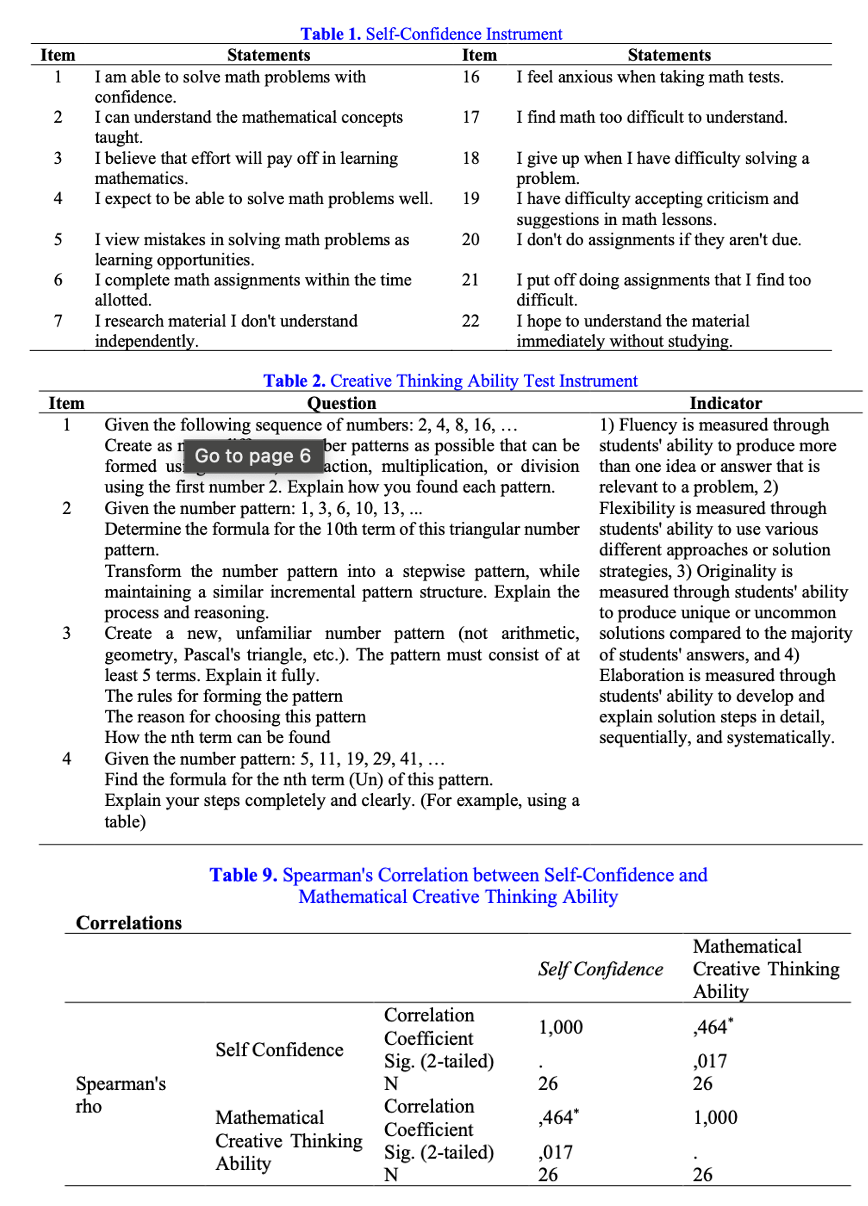
Mathematical creative thinking ability and self-confidence are two important interrelated aspects in mathematics learning. Self-confidence plays a role in encouraging students' courage to put forward ideas, try various problem-solving strategies, and persevere when facing difficulties, thus potentially supporting the development of mathematical creative thinking ability. Therefore, a study on the relationship between self-confidence and mathematical creative thinking ability is important to understand the contribution of the affective aspect to the development of students' cognitive abilities. This study used a quantitative approach with a correlational method to analyze the relationship between the two variables. The subjects were eighth-grade students of SMP Negeri 8 Garut who were selected using a purposive sampling technique. Data were collected through a self-confidence questionnaire and a mathematical creative thinking ability test in the form of descriptive questions. The questionnaire and test instruments have undergone validity and reliability tests to ensure the feasibility of measuring each research variable. Based on the results of the descriptive analysis, it is known that the majority of students have self-confidence in the medium category (54%), while mathematical creative thinking ability is in the medium category (38%). Because one of the data is not normally distributed, inferential analysis was conducted using the Spearman correlation test. The results of this test indicate a significant positive relationship between self-confidence and mathematical creative thinking ability, with a correlation coefficient of 0.464 and a significance value of 0.017 < 0.05. Thus, it can be concluded that the higher the student's self-confidence, the better the mathematical creative thinking ability they have. This shows that self-confidence contributes to mathematical creative thinking ability, although it is not the only influencing factor.
Downloads
References
Aeni, E. E. Z., Nurfahriani, I., & Kadarisma, G. (2018). Hubungan Kepercayaan Diri dan Kemampuan Penalaran Matematis Siswa Smp. JPMI (Jurnal Pembelajaran Matematika Inovatif), 1(4), 531. https://doi.org/10.22460/jpmi.v1i4.p531-538
Anditiasari, N., Pujiastuti, E., & Bambang, E. S. (2021). Systematic Literature Review: Pengaruh Motivasi terhadap Kemampuan Berpikir Kreatif Matematis Siswa. AKSIOMA: Jurnal Matematika Dan Pendidikan Matematika, 12(2). https://doi.org/10.26877/aks.v12i2.8884
Andiyana, M. A., Maya, R., & Hidayat, W. (2018). Analisis Kemampuan Berpikir Kreatif Matematis Siswa SMP Pada Materi Bangun Ruang. JPMI: Jurnal Pembelajaran Matematika Inovatif, 1(3). https://doi.org/10.22460/jpmi.v1i3.239-248
Ayuningsih, R. F., Andrianto, D., & Kurniawan, W. (2025). Integrasi Model Pembelajaran Blended Learning dan Flipped Classroom: Strategi Efektif dalam Pembelajaran Abad Ke-21. STRATEGY: Jurnal Inovasi Strategi Dan Model Pembelajaran, 5(1). https://doi.org/10.51878/strategi.v5i1.4942
Bandura, A. (1997). Self-efficacy (4th ed.). Cambridge: Cambridge University Press. https://doi.org/https://doi.org/10.1002/9781118970843.ch243
Dalilan, R., & Sofyan, D. (2022). Kemampuan Berpikir Kreatif Matematis Siswa SMP ditinjau dari Self Confidence. PLUSMINUS: Jurnal Pendidikan Matematika, 2(1), 141–150. https://doi.org/10.31980/plusminus.v2i1.1092
Ernitasari, A. O., Susanto, Safrida, N. L., Sunardi, & Oktavianingtyas, E. (2022). Keterampilan Berpikir Kreatif Siswa dalam Menyelesaikan Masalah Segiempat ditinjau dari Self-Confidence. JPMI: Jurnal Pembelajaran Matematika Inovatif, 5(5). https://doi.org/10.22460/jpmi.v5i5.1231-1242
Fardani, Z., Surya, E., & Mulyono. (2021). Pembelajaran Matematika Melalui Model Problem Based Learning. Jurnal Pendidikan Matematika, 14(1), 39–51. https://doi.org/10.24114/paradikma.v14i1.24809
Firdausi, Y. N., Asikin, M., & Wuryanto. (2018). Analisis Kemampuan Berpikir Kreatif Siswa Ditinjau dari Gaya Belajar pada Pembelajaran Model Eliciting Activities ( MEA ). PRISMA: Prosiding Seminar Nasional Matematika, 1, 239–247. https://doi.org/10.28926/jtpdm.v5i1.1881
Gusteti, M. U., & Neviyarni. (2022). Pembelajaran Berdiferensiasi pada Pembelajaran Matematika Di Kurikulum Merdeka. Lebesgue: Jurnal Ilmiah Pendidikan Matemati, Matematika Dan Statistika, 3(3), 170–184. https://doi.org/10.4324/9781003175735-15
Huliatunisa, Y., Wibisana, E., & Hariyani, L. (2019). Analisis Kemampuan Berpikir Kreatif Matematis Siswa dalam Menyelesaikan Soal Pemecahan Masalah. Indonesian Journal of Elementary Education, 1(1). http://jurnal.umt.ac.id/index.php/IJOEE
Istiqomah, Q., & Nurulhaq, C. (2021). Perbandingan Kemampuan Koneksi Matematis Siswa antara Model Pembelajaran Discovery Learning dan Ekspositori. Plusminus: Jurnal Pendidikan Matematika, 1(1), 135–144. https://doi.org/10.31980/plusminus.v1i1.1032
Isyana, B. V., Novitasari, D., & Sridana, N. (2024). Pengaruh Self Confidence terhadap Hasil Belajar Matematika Siswa Kelas VIII SMP. Mandalika Mathematics and Education Journal, 6(1), 370. https://doi.org/10.29303/jm.v3i1.7125
Khoirotunnisa, A. U., & Irhadtanto, B. (2020). Pengaruh Model Pembelajaran Flipped Classroom Tipe Traditional Flipped Berbantuan Video terhadap Kemampuan Berpikir Kreatif Siswa pada Materi Bangun Ruang Sisi Datar. JPE (Jurnal Pendidikan Edutama, 7(2). https://doi.org/10.30734/jpe.v7i2.768
Maryati, I., & Nurkayati, N. (2021). Analisis Kemampuan Berpikir Kreatif Matematis Siswa Sekolah Menengah Atas dalam Materi Aljabar. PYTHAGORAS Jurnal Pendidikan Matematika, 16(2), 253–265. https://doi.org/10.21831/pythagoras.v16i2.40007
Masfufah, R., & Afriansyah, E. A. (2021). Analisis Kemampuan Literasi Matematis Siswa melalui Soal PISA. Mosharafa: Jurnal Pendidikan Matematika, 10(2), 291–300. https://doi.org/10.31980/mosharafa.v10i2.662
Revanda, S., Wijayanti, S. N., Yunain, S., Syarifudin, S., Aprilia, S., Mahfufatal, S., & Malika, N. (2024). Integrasi Pembelajaran Abad 21 dalam 4C (Communication, Creativity and Inovation, Collaboration, Critical Thinking) di Pondok Pesantren Sulamul Huda Siwalan. Muaddib: Jurnal Pendidikan Agama Islam, 2(2), 32–45. https://doi.org/10.62383/dilan.v2i2.1551
Rozi, F. A., & Afriansyah, E. A. (2022). Analisis Kemampuan Berpikir Kreatif Matematis Berdasarkan Disposisi Matematis Siswa. Journal of Authentic Research on Mathematics Education (JARME), 4(2), 172–185. https://doi.org/10.37058/jarme.v4i2.4880
Sari, R. A., & Untarti, R. (2021). Kemampuan Berpikir Kreatif Matematis dan Resiliensi Matematis. Mandalika Mathematics and Education Journal, 3(1). https://doi.org/10.29303/jm.v3i1.2577
Sari, R. F., & Afriansyah, E. A. (2022). Kemampuan Berpikir Kreatif Matematis dan Belief Siswa pada Materi Persamaan dan Pertidaksamaan Linear. PLUSMINUS: Jurnal Pendidikan Matematika, 2(2). https://doi.org/10.31980/plusminus.v2i2.1104
Trisnawati, I., Pratiwi, W., Nurfauziah, P., & Maya, R. (2018). Analisis Kemampuan Berpikir Kreatif Matematis Siswa SMA Kelas XI Pada Materi Trigonometri Ditinjau Dari Self-Confidence. JPMI: Jurnal Pembelajaran Matematika Inovatif, 1(3). https://doi.org/10.22460/jpmi.v1i3.383-394
Wathoni, M. H., & Negara, H. R. P. (2024). Kemampuan Berpikir Kreatif Matematis Siswa dalam Menyelesaikan Soal Lingkaran Ditinjau dari Habits Of Mind. Journal of Didactic Mathematics, 5(1), 57–69. https://doi.org/10.34007/jdm.v5i1.2199
Wulandari, W., Danaryanti, A., & Mawaddah, S. (2021). Kemampuan Berpikir Kreatif Siswa MAN dalam Pembelajaran Matematika Menggunakan Model Guided Inquiry. Jurmadikta, 1(2), 29–38. https://doi.org/10.20527/jurmadikta.v1i2.796
Downloads
Published
How to Cite
Issue
Section
License
Copyright (c) 2026 Elsa Rohmania, Iyam Maryati

This work is licensed under a Creative Commons Attribution-ShareAlike 4.0 International License.
Education and Talent Development Center of Indonesia (ETDC Indonesia)
e-mail: kognitif@gmail.com, website : https://etdc-indonesia.com

Kognitif: Jurnal Riset HOTS Pendidikan Matematika dengan Situs: https://etdci.org/journal/kognitif berlisensi Creative Commons Attribution-ShareAlike 4.0 International License






.png)