Relationship Between Students’ Learning Interest and Mathematical Critical Thinking Skills Students in Statistics

https://doi.org/10.51574/kognitif.v6i1.4193
Keywords:
Learning Interest , Mathematical Critical Thinking Skills , Correlation , Mathematics Learning StatisticsAbstract
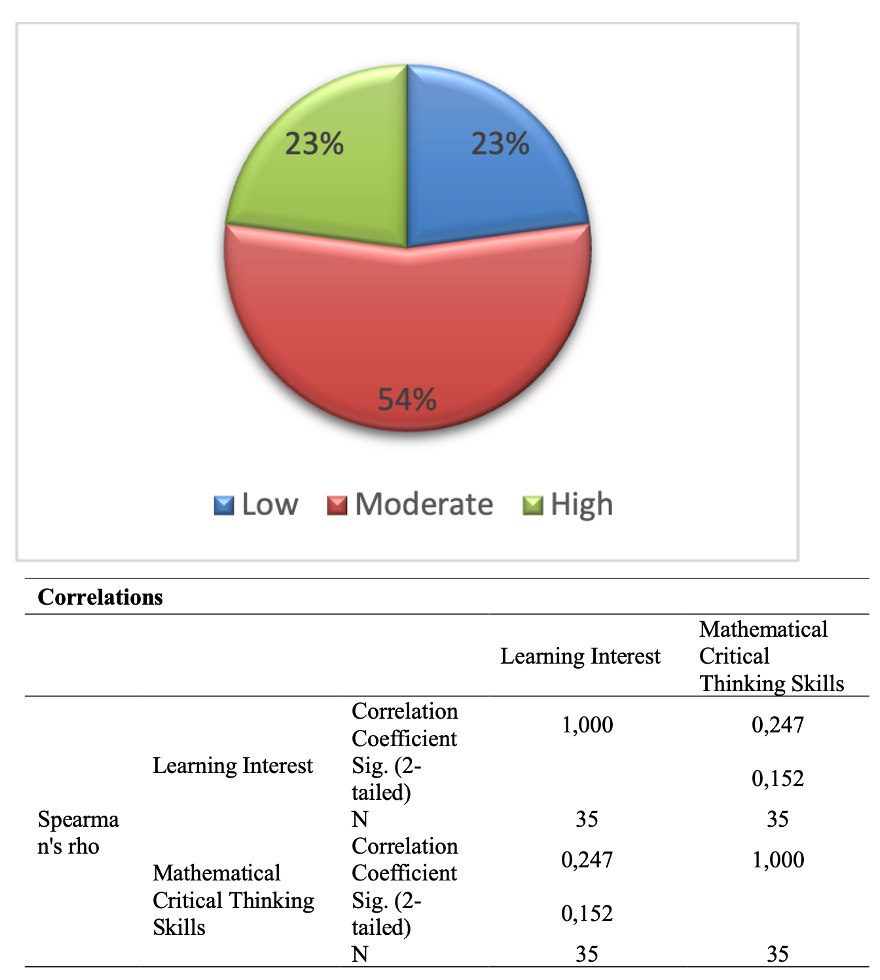
The urgency of this research is based on the importance of developing critical thinking skills in 21st-century mathematics education, as well as the assumption that learning interest is one of the internal factors contributing to these skills. This study aims to analyze the relationship between students’ learning interest and mathematical critical thinking skills students in Statistics. The study employed a quantitative approach with a correlational method. The sample consisted of 35 Grade X students from a public senior high school in Garut Regency, selected through purposive sampling. The research instruments included a learning interest questionnaire developed based on four main indicators and an essay test measuring mathematical critical thinking skills constructed in accordance with critical thinking indicators. The instruments were validated through expert judgment for content validity, and reliability testing was conducted using Cronbach’s Alpha coefficient for the questionnaire and internal consistency testing for the essay test. Data were analyzed using the Shapiro–Wilk normality test, followed by Spearman’s rho correlation test since one of the variables was not normally distributed. The results showed a correlation coefficient of 0.247 with a significance value of 0.152 (p > 0.05), indicating a weak and statistically non-significant positive relationship between learning interest and mathematical critical thinking skills. The novelty of this study lies in examining the relationship between the two variables specifically in the Statistics topic at the senior high school level. The findings imply that improving mathematical critical thinking skills cannot rely solely on enhancing students’ learning interest but must also be supported by instructional strategies that promote higher-order thinking activities.
Downloads
References
Apriyanto, M. T., & Herlina, L. (2020). Analisis Prestasi Belajar Matematika pada Masa Pandemi Ditinjau dari Minat Belajar Siswa. Seminar Nasional Dan Diskusi Panel Pendidikan Matematika, 6(1), 135–144.
Arifin, M. (2020). Strategi Pembelajaran Numbered Head Together (NHT) dalam Meningkatkan Minat Belajar Siswa Pada Materi Statistika. Jurnal Didactical Mathematics, 2(2), 10–20. https://doi.org/10.31949/dmj.v2i2.2074
Asih, A., & Imami, A. I. (2021). Analisis Minat Belajar Siswa Smp Pada Pembelajaran Matematika. Jurnal Pembelajaran Matematika Inovatif, 4(4), 799–808. https://doi.org/10.22460/jpmi.v4i4.799-808
Atikah, N., & Jumrah. (2024). Pengaruh Minat Terhadap Hasil Belajar Matematika Siswa. Al-Irsyad Journal Of Mathematics Educations, 4(2), 100–113. https://doi.org/10.58917/ijme.v3i2.127
Batara, D. R., Ardiansyah, R., Yanwas, Y. B., Naumi, N., & Slamet, R. A. (2025). Langkah-langkah Menentukan Populasi dan Sampel yang Tepat dalam Penelitian. Jurnal Penelitian Ilmu Pendidikan Indonesia, 4(2), 682–689. https://doi.org/10.31004/jpion.v4i2.457
Hartanti, N. (2019). Pengaruh Kecerdasan Logis Matematis dan Kemampuan Berpikir Kritis terhadap Kemampuan Pemecahan Masalah Matematika. Alfarisi: Jurnal Pendidikan MIPA, 2(3), 267–274. https://journal.lppmunindra.ac.id/index.php/alfarisi/article/view/5744/3955
Hasibuan, L., Elindra, R., & Harahap, S. D. (2022). Analisis Kemampuan Berpikir Kritis Di Tinjau Dari Minat Belajar Matematika Siswa Selama Pandemi. Jurnal MathEdu (Mathematic Education Journal), 5(1). https://doi.org/10.37081/mathedu.v5i1.2737
Ismayanti, W., Santosa, C. A. H. F., & Rafianti, I. (2022). Minat Belajar, Efikasi Diri, dan Kemampuan Berpikir Kritis Berpengaruh Terhadap Hasil Belajar Matematika Siswa. Jurnal Educatio FKIP UNMA, 8(3), 943–952. https://doi.org/10.31949/educatio.v8i3.2847
Juliyantika, T., & Batubara, H. H. (2022). Tren Penelitian Keterampilan Berpikir Kritis pada Jurnal Pendidikan Dasar di Indonesia. Jurnal Basicedu, 6(3), 4731–4744. https://doi.org/10.31004/basicedu.v6i3.2869
Lestari, S. Z. D., & Roesdiana, L. (2021). Analisis Kemampuan Berpikir Kritis Matematis Siswa Smp Pada Materi Himpunan. Maret, 8(1), 82–90. https://www.neliti.com/publications/502852/analisis-kemampuan-berpikir-kritis-matematis-siswa-smp-pada-materi-himpunan
Maesaroh, S. (2021). Kemampuan Berpikir Kritis Matematis Siswa SMP pada Materi Bangun Ruang Sisi Datar. Jurnal Riset Intervensi Pendidikan (JRIP), 3(2), 99–105. http://journal.rekarta.co.id/index.php/jrip/
Mesra, P., Kuntarto, E., & Chan, F. (2021). Faktor – Faktor Yang Mempengaruhi Minat Belajar Siswa di Masa Pandemi. Jurnal Ilmiah Wahana Pendidikan, 7(3), 177–183. https://doi.org/10.5281/zenodo.5037881
Ni’mah, U., Ermawati, D., & Amaliyah, F. (2025). Analisis Faktor-Faktor Yang Mempengaruhi Kemampuan Berpikit Kritis Siswa Dalam Menyelesaikan Soal Matematika. Mathematic Education Journal)MathEdu, 8(1). https://doi.org/10.37081/mathedu.v8i1.6972
Ningrum, M., Karsono, & Adi, F. P. (2023). Hubungan antara minat belajar dengan kemampuan berpikir kritis matematis peserta didik kelas V sekolah dasar. Didaktika Dwija Indria, 4(11), 31–36. https://doi.org/10.20961/ddi.v11i4.77153
Nugroho, M. A., Muhajang, T., & Budiana, S. (2020). Pengaruh Minat Belajar Siswa Terhadap Hasil Belajar Mata Pelajaran Matematika. Jurnal Pendidikan Dan Pengajaran Guru Sekolah Dasar (JPPGuseda), 03(01), 42–46. https://doi.org/10.55215/jppguseda.v3i1.2014
Pertiwi, W. (2018). Analisis Kemampuan Berpikir Kritis Matematis Peserta Didik Smk Pada Materi Matriks. Jurnal Pendidikan Tambusai, 2(4), 793–801.
Rosmaini, R. (2023). Analisis Faktor-Faktor yang Mempengaruhi Kemampuan Berpikir Kritis dalam Pembelajaran Matematika. Edukatif : Jurnal Ilmu Pendidikan, 5(2), 869–879. https://doi.org/10.31004/edukatif.v5i2.4767
Siswanto, R. D., & Ratiningsih, R. P. (2020). Korelasi Kemampuan Berpikir Kritis dan Kreatif Matematis dengaan Pemecahan Masalah Matematis Materi Bangun Ruang. ANARGYA: Jurnal Ilmiah Pendidikan Matematika, 3(2), 96–103. https://doi.org/10.24176/anargya.v3i2.5197
Sugiyono. (2023). Metode Penelitian Kuantitatif, Kualitatif, dan R&D (S. Sutopo, Ed.; Ke-5 I Tahun 2023). Penerbit ALFABETA .
Syafitri, E., Armanto, D., & Rahmadani, E. (2021). Aksiologi Kemampuan Berpikir Kritis. Journal of Science and Social Research, 4(3), 320–325. https://doi.org/10.54314/jssr.v4i3.682
Syafruddin, I. S., & Pujiastuti, D. H. (2020). Analisis Kemampuan Berpikir Kritis Matematis: Studi Kasus pada Siswa MTs Negeri 4 Tangerang. Suska Journal of Mathematics Education, 6(2), 89–100. https://doi.org/10.24014/sjme.v6i2.9436
Wijaya, R., Vioreza, N., & Marpaung, J. B. (2022). Penggunaan Media Konkret dalam Meningkatkan Minat Belajar Matematika. Prosiding Seminar Nasional Pendidikan STKIP Kusuma Negara III SEMNARA 2021, 580–586. https://jurnal.stkipkusumanegara.ac.id/index.php/semnara2020/article/view/1361
Wijayanti, A., Nursaadah, I., Faslurrohman, M., Muna, K., Rohmah, U. S., & Dewanti, S. S. (2024). Penilaian otentik kemampuan berpikir kritis matematis siswa SMP Kelas VIII pada materi statistika. Jurnal Math Educator Nusantara: Wahana Publikasi Karya Tulis Ilmiah Di Bidang Pendidikan Matematika, 10(1), 23–40. https://doi.org/10.29407/jmen.v10i1.20266
Downloads
Published
How to Cite
Issue
Section
License
Copyright (c) 2026 Nurul Silpia, Undang Indrajaya

This work is licensed under a Creative Commons Attribution-ShareAlike 4.0 International License.
Education and Talent Development Center of Indonesia (ETDC Indonesia)
e-mail: kognitif@gmail.com, website : https://etdc-indonesia.com

Kognitif: Jurnal Riset HOTS Pendidikan Matematika dengan Situs: https://etdci.org/journal/kognitif berlisensi Creative Commons Attribution-ShareAlike 4.0 International License






.png)