Ethno-Biomathematics for Junior High School Students' Understanding of Cell Structure: A Case Study

https://doi.org/10.51574/kognitif.v6i1.4221
Keywords:
Biology, Cell Structure, Ethnomathematics, Geometric Patterns, Junior High SchoolAbstract
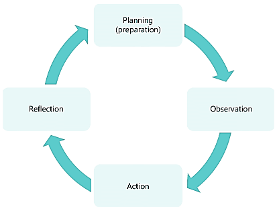
Biology learning at the junior high school level, particularly regarding the structure of plant cells and tissues, is often considered difficult due to its microscopic and abstract characteristics. This study intends to integrate ethnomathematics (the study of mathematical concepts in local culture and environment) as a contextual bridge to facilitate student understanding. We conducted this case study at a junior high school in Wajo Regency, using the Classroom Action Research (CAR) method with a qualitative descriptive design. The research stages include (1) identification of local ethnomathematics; (2) development of teaching materials; and (3) implementation and observation. The findings indicated that the incorporation of ethnomathematics substantially enhanced students' visualization abilities and contextual comprehension. Students more easily internalized the concept of efficient tiling (hexagonal patterns) in plant tissues after analyzing similar patterns found in flora in their surrounding environment. This approach transformed learning into a more active and meaningful one by concretizing abstract material through locally relevant mathematical objects. This study concludes that using native botanical geometric patterns is a creative strategy that shifts the paradigm of biological learning from mere memorization to contextual exploration, while simultaneously improving students' numeracy literacy.
Downloads
References
Aikenhead, G. S. (2017). Enhancing school mathematics culturally: A path of reconciliation. Canadian Journal of Science, Mathematics and Technology Education, 17(2), 73-140. https://doi.org/10.1080/14926156.2017.1308043
Albanese, V., & Perales, F. J. (2020). Mathematics conceptions by teachers from an ethnomathematical perspective. Bolema: Boletim de Educação Matemática, 34(66), 1-21. https://doi.org/10.1590/1980-4415v34n66a01
Asy'arie, B. F., Aziz, M. H., Bahy, M. B. A., Rahman, A., & Mariyana, W. (2025). Kurikulum merdeka belajar: menelaah trend model pembelajaran di sekolah dan madrasah. Jurnal Pendidikan Dasar dan Keguruan, 10(1), 1-15. https://doi.org/10.47435/jpdk.v10i1.3233
Augusto, I., Monteiro, D., Girard-Dias, W., Dos Santos, T. O., Rosa Belmonte, S. L., Pinto de Oliveira, J., ... & Guimarães, M. C. C. (2016). Virtual reconstruction and three-dimensional printing of blood cells as a tool in cell biology education. PloS one, 11(8), e0161184. https://doi.org/10.1371/journal.pone.0161184
Byukusenge, C., Nsanganwimana, F., & Paulo Tarmo, A. (2023). Difficult topics in the revised biology curriculum for advanced level secondary schools in Rwanda: teachers’ perceptions of causes and remedies. Journal of Biological Education, 57(5), 1112-1128. https://doi.org/10.1080/00219266.2021.2012225
Carolina, H. S., Riandi, R., & Rochintaniawati, D. (2024). Integrasi Potensi Lokal dalam Implementasi Kurikulum Merdeka. Al Jahiz: Journal of Biology Education Research, 5(2), 125-137. https://e-journal.metrouniv.ac.id/Al-Jahiz/article/view/9413
Deda, Y. N., Disnawati, H., Tamur, M., & Rosa, M. (2024). Global trend of ethnomathematics studies of the last decade: A bibliometric analysis. Infinity Journal, 13(1), 233-250. https://doi.org/10.22460/infinity.v13i1.p233-250
D’Ambrosio, U., & Rosa, M. (2017). Ethnomathematics and its pedagogical action in mathematics education. In Ethnomathematics and its diverse approaches for mathematics education (pp. 285-305). Cham: Springer International Publishing. https://doi.org/10.1007/978-3-319-59220-6_12
Eglash, R. (2023). Ethno-biomathematics: A decolonial approach to mathematics at the intersection of human and nonhuman design. In Ubiratan D’Ambrosio and mathematics education: Trajectory, legacy and future (pp. 289-303). Cham: Springer International Publishing. https://doi.org/10.1007/978-3-031-31293-9_18
Fauziah, D. A., Erman, E., Susiyawati, E., & Budiyanto, M. (2023). Implementation of project-based learning models to improve science literacy of junior high school students. Jurnal Pijar Mipa, 18(2), 176-182. https://doi.org/10.29303/jpm.v18i2.4795
Frankenstein, M., & Powell, A. B. (2023). The political dimension of Ubi D’Ambrosio’s theorizations of ethnomathematics: Criticalethnomathematics. In Ubiratan D’ambrosio and mathematics education: Trajectory, legacy and future (pp. 203-239). Cham: Springer International Publishing. https://doi.org/10.1007/978-3-031-31293-9_14
Hartoyo, A., Fitriawan, D., Siregar, N., & Putra, F. G. (2025). Connecting cultural roots with mathematical thinking: A comprehensive meta-analysis of ethnomathematics practices in indonesian classrooms. Al-Jabar: Jurnal Pendidikan Matematika, 16(2), 673-689. https://doi.org/10.24042/ajpm.v16i2.28734
Jacob, E. E., & Dike, J. W. (2023). Ethnomathematics and culturally responsive pedagogy in mathematics learning. Journal of Education in Developing Areas, 31(3), 380-389. https://journals.journalsplace.org/index.php/JEDA/article/view/410
Jenkinson, J. (2018). Molecular biology meets the learning sciences: Visualizations in education and outreach. Journal of molecular biology, 430(21), 4013-4027. https://doi.org/10.1016/j.jmb.2018.08.020
Johann, L. I., Rusk, F. K., Reiss, M. J., & Groß, J. (2024). Upper secondary students’ thinking pathways in cell membrane biology–an evidence-based development and evaluation of learning activities using the Model of Educational Reconstruction. Journal of Biological Education, 58(1), 144-165. https://doi.org/10.1080/00219266.2022.2026805
Kabuye Batiibwe, M. S. (2024). The role of ethnomathematics in mathematics education: A literature review. Asian Journal for Mathematics Education, 3(4), 383-405. https://doi.org/10.1177/27527263241300400
Laili, E. N., Sulisawati, D. N., & Hidayatin, N. (2025). Ethnomathematics of Geometric Transformation in Knitting Mosaic Patterns with Terrazzo Motifs. ETDC: Indonesian Journal of Research and Educational Review, 4(4), 1062-1074. https://doi.org/10.51574/ijrer.v4i4.3689
Lidinillah, D. A. M., Rahman, R., Wahyudin, W., & Aryanto, S. (2022). Integrating sundanese ethnomathematics into mathematics curriculum and teaching: A systematic review from 2013 to 2020. Infinity Journal, 11(1), 33-54. https://doi.org/10.22460/infinity.v11i1.p33-54
Machaba, F., & Dhlamini, J. (2021). Ethnomathematics as a fundamental teaching approach. In Mathematics teaching and professional learning in sub-Sahara Africa (pp. 59-76). Cham: Springer International Publishing. https://doi.org/10.1007/978-3-030-82723-6_5
Maret, W., & Blower, P. (2022). Teaching the chemical elements in biochemistry: Elemental biology and metallomics. Biochemistry and Molecular Biology Education, 50(3), 283-289. https://doi.org/10.1002/bmb.21614
Mayasari, A. (2023). Factors Affecting Junior High School Students' Scientific Literacy: An Empirical Study. Jurnal Penelitian Pendidikan IPA, 9(10), 8341-8350. https://doi.org/10.29303/jppipa.v9i10.5377
Nehm, R. H. (2019). Biology education research: Building integrative frameworks for teaching and learning about living systems. Disciplinary and Interdisciplinary Science Education Research, 1(1), 15. https://doi.org/10.1186/s43031-019-0017-6
Owens, K. (2014). Diversifying our perspectives on mathematics about space and geometry: An ecocultural approach. International Journal of Science and Mathematics Education, 12(4), 941-974. https://doi.org/10.1007/s10763-013-9441-9
Prahmana, R. C. I. (2022). Ethno-realistic mathematics education: The promising learning approach in the city of culture. SN Social Sciences, 2(12), 257. https://doi.org/10.1007/s43545-022-00571-w
Pratama, R. A., & Yelken, T. Y. (2024). Effectiveness of ethnomathematics-based learning on students’ mathematical literacy: a meta-analysis study. Discover Education, 3(1), 202. https://doi.org/10.1007/s44217-024-00309-1
Pujiastuti, H., & Haryadi, R. (2024). The effectiveness of using augmented reality on the geometry thinking ability of junior high school students. Procedia Computer Science, 234, 1738-1745. https://doi.org/10.1016/j.procs.2024.03.180
Purwandari, W., Safitri, I. N., & Karimah, M. M. (2024). Eksplorasi Hakekat Pembelajaran Matematika di Madrasah Ibtidaiyah dalam Konteks Kurikulum Merdeka. Indonesian Research Journal on Education, 4(4), 1045-1060. https://doi.org/10.31004/irje.v4i4.1130
Rosa, M. (2023). Influences and contributions of Ubiratan D’Ambrosio in the development of ethnomodelling as a research concept related to ethnomathematics and modelling. In Ubiratan D’Ambrosio and Mathematics Education: Trajectory, Legacy and Future (pp. 145-162). Cham: Springer International Publishing. https://doi.org/10.1007/978-3-031-31293-9_11
Rosa, M., & Orey, D. C. (2017). STEM education in the Brazilian context: An ethnomathematical perspective. In STEM education in the junior secondary: The state of play (pp. 221-247). Singapore: Springer Singapore. https://doi.org/10.1007/978-981-10-5448-8_11
Sari, A., Putri, R. I. I., & Prahmana, R. C. I. (2024). Ethnomathematics in Indonesian Woven Fabric: The Promising Context in Learning Geometry. Mathematics Teaching Research Journal, 16(5), 157-185. https://eric.ed.gov/?id=EJ1464260
Sinaga, P., & Setiawan, W. (2022). The impact of electronic interactive teaching materials (EITMs) in e-learning on junior high school students’ critical thinking skills. Thinking Skills and Creativity, 46, 101066. https://doi.org/10.1016/j.tsc.2022.101066
Sunzuma, G., & Umbara, U. (2025). Ethnomathematics-based technology in Indonesia: A systematic review. Asian Journal for Mathematics Education, 4(1), 129-153. https://doi.org/10.1177/27527263241305812
Syahrial, A. (2024). Analisis Pembelajaran Fisika Terintegrasi Steam Untuk Melatih Keterampilan Abad 21 Dan Keterampilan Proses Sains Siswa Pada Implementasi Kurikulum Merdeka: A Review. Journal of Classroom Action Research, 6(4), 881-892. https://doi.org/10.29303/jcar.v6i4.5932
Tegmark, M. (2008). The mathematical universe. Foundations of physics, 38(2), 101-150. https://doi.org/10.1007/s10701-007-9186-9
Trisnani, N., & Utami, W. T. P. (2021). Ethnomathematics-based learning tools. International Journal of Elementary Education, 5(4), 593-600. https://doi.org/10.23887/ijee.v5i4.40574
Turmuzi, M., Suharta, I. G. P., & Suparta, I. N. (2023). Ethnomathematical research in mathematics education journals in Indonesia: A case study of data design and analysis. Eurasia Journal of Mathematics, Science and Technology Education, 19(1), em2220. https://doi.org/10.29333/ejmste/12836
Varella, M. A. C. (2018). The biology and evolution of the three psychological tendencies to anthropomorphize biology and evolution. Frontiers in Psychology, 9, 1839. https://doi.org/10.3389/fpsyg.2018.01839
Verner, I., Massarwe, K., & Bshouty, D. (2019). Development of competencies for teaching geometry through an ethnomathematical approach. The Journal of Mathematical Behavior, 56, 100708. https://doi.org/10.1016/j.jmathb.2019.05.002
Vydra, M., & Kováčik, J. (2025). Teacher characteristics influencing plant biology education: Age, perception, and practical engagement. Theoretical and Experimental Plant Physiology, 37(1), 9. https://doi.org/10.1007/s40626-024-00351-2
Wikasari, R., Pardi, H. H., & Negara, H. R. P. (2025). Effects of Ethnomathematics-Based Problem-Based Learning on Students’ Conceptual Understanding in Mathematics. Kognitif: Jurnal Riset HOTS Pendidikan Matematika, 5(3), 1409-1421. https://doi.org/10.51574/kognitif.v5i3.3855
Downloads
Published
How to Cite
Issue
Section
License
Copyright (c) 2026 Muhammad Hasbi, Fitri

This work is licensed under a Creative Commons Attribution-ShareAlike 4.0 International License.
Education and Talent Development Center of Indonesia (ETDC Indonesia)
e-mail: kognitif@gmail.com, website : https://etdc-indonesia.com

Kognitif: Jurnal Riset HOTS Pendidikan Matematika dengan Situs: https://etdci.org/journal/kognitif berlisensi Creative Commons Attribution-ShareAlike 4.0 International License






.png)