Development of an Instrument to Measure Problem Solving and Numeracy Literacy Based on Ethnomathematics

https://doi.org/10.51574/kognitif.v6i1.4738
Keywords:
Problem Solving , Numeracy Literacy , Ethnomathematics , Assessment Instrument , Mathematics EducationAbstract
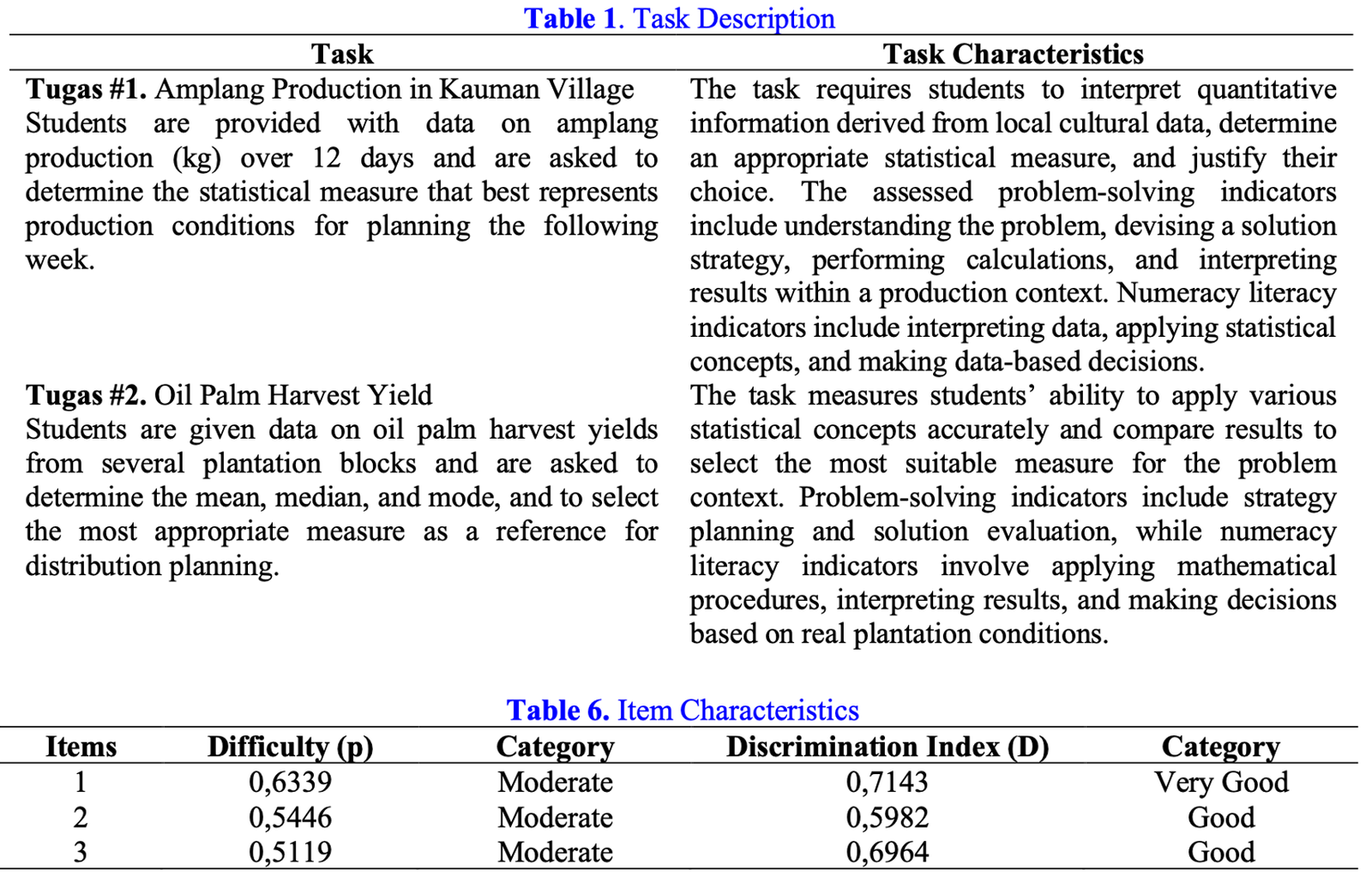
Problem solving and numeracy literacy are essential competencies in 21st-century mathematics education, as they require students to understand, apply, and interpret mathematical concepts in real-world contexts. However, school assessments remain predominantly procedural and have not comprehensively measured these competencies. This study aimed to develop a contextual essay-based test instrument grounded in ethnomathematics to assess senior high school students’ problem solving and numeracy literacy skills. This research employed a research and development (R&D) method, including needs analysis, test blueprint design, item development, expert validation, limited field testing, and item analysis using the Classical Test Theory approach supported by SPSS. The trial involved 28 twelfth-grade students of SMA Negeri 1 Ketapang. The results showed that the instrument demonstrated very high content validity (average 95.31%) and empirical validity, as student responses reflected the indicators of problem solving and numeracy literacy based on the analytic rubric. The reliability coefficients were very high, with Cronbach’s Alpha values of 0.907 for problem solving and 0.918 for numeracy literacy. All items were categorized as having moderate difficulty levels and good to very good discrimination indices. The novelty of this study lies in the simultaneous integration of Polya’s problem-solving stages and the PISA numeracy framework into an empirically validated assessment instrument based on local ethnomathematical contexts. This instrument provides a more contextual and authentic alternative for assessing higher-order thinking skills in mathematics.
Downloads
References
Alo, R. (2025). Numerical Literacy Orientation and Mathematical Problem-Solving Skills among Senior High School Students. Asia Pacific Journal of Educational Technologies, Psychology, and Social Sciences, 1(2), 1–15. https://doi.org/10.70847/628900
Andriani, S., Ermika, T., Izzati, N., Putri, A. R., & Mardani, H. S. (2025). Investigating Students’ Mathematical Problem-Solving Abilities in the Context of Social Arithmetic through the Lens of Learning Styles. Kognitif: Jurnal Riset HOTS Pendidikan Matematika, 5(4). https://doi.org/10.51574/kognitif.v5i4.3636
Astuti, N., & Jana, P. (2022). Pengembangan LKS Berbasis Etnomatematika untuk Memfasilitasi Kemampuan Representasi Matematis. Edumatica: Jurnal Pendidikan Matematika, 12(2), 180–194. https://doi.org/10.22437/edumatica.v12i02.15814
Baharuddin, A., Alannasir, W., & Musbaing, M. (2025). The Effect of Problem Solving Learning Model on Literacy and Numeracy of Grade IV Students. ALENA : Journal of Elementary Education, 3(1), 51–62. https://doi.org/10.59638/jee.v3i1.287
Bishop, A. J. (1988). Mathematical Enculturation. Springer Netherlands. https://doi.org/10.1007/978-94-009-2657-8
Faishol, A., Waris, & Adhim, F. (2025). Developing Assessment Instrument of Literacy and Numeracy in Elementary School. Jurnal Penelitian Pendidikan IPA, 11(9), 431–439. https://doi.org/10.29303/jppipa.v11i9.11772
Fitri, A., & Sari, A. C. (2025). Development of an Ethnomathematics Module Based on the Pancasila Student Profile in Learning Flat and Solid Geometry. Prisma Sains : Jurnal Pengkajian Ilmu Dan Pembelajaran Matematika Dan IPA IKIP Mataram, 13(2), 221. https://doi.org/10.33394/j-ps.v13i2.14690
Isnaintri, E., Yuhana, Y., & Fatah, A. (2024). Enhancing Problem-Solving Skills Through Numeracy Instrument Design: Incorporating Pandeglang’s Local Wisdom in Geometry Content. Kalamatika: Jurnal Pendidikan Matematika, 9(1), 49–64. https://doi.org/10.22236/kalamatika.vol9no1.2024pp49-64
Mahdiansyah, & Rahmawati. (2014). Literasi Matematika Siswa Pendidikan Menengah: Analisis Menggunakan Desain Tes Internasional dengan Konteks Indonesia. Jurnal Pendidikan Dan Kebudayaan, 20(4), 452–469. https://repositori.kemendikdasmen.go.id/540/1/2.%20mahdiansyah.pdf
Munawarah, Novianty, R., Nur, F., Mattoliang, L. A., & Thalhah, S. Z. (2025). Development of Ethnomathematics-Based Test Instrument to Measure Critical Thinking Ability. Formatif: Jurnal Ilmiah Pendidikan MIPA, 15(1). https://doi.org/10.30998/formatif.v15i1.25886
Muntazhimah, Mawaddah, M., & Zakiyah, S. (2025). E-Worksheet Berbasis Etnomatematika: Inovasi Pembelajaran untuk Meningkatkan Kemampuan Pemecahan Masalah Matematika. AKSIOMA: Jurnal Program Studi Pendidikan Matematika, 14(3), 736–747. https://doi.org/10.24127/ajpm.v14i3.13305
Niss, M., & Højgaard, T. (2019). Mathematical competencies revisited. Educational Studies in Mathematics, 102(1), 9–28. https://doi.org/10.1007/s10649-019-09903-9
OECD. (2019). PISA 2018 Assessment and Analytical Framework. OECD Publishing. https://doi.org/10.1787/b25efab8-en
OECD. (2021). OECD Skills Outlook 2021. OECD Publishing. https://doi.org/10.1787/0ae365b4-en
OECD. (2023). PISA 2022 Results (Volume I). OECD Publishing. https://doi.org/10.1787/53f23881-en
Polya, G. (1973). Polya 1973 (2nd ed.). Princeton University Press. https://www.hlevkin.com/hlevkin/90MathPhysBioBooks/Math/Polya/George_Polya_How_To_Solve_It_.pdf
Rohim, A., & Rofiki, I. (2024). Profil Kemampuan Berpikir Kritis Siswa dalam Menyelesaikan Soal AKM Numerasi. Kognitif: Jurnal Riset HOTS Pendidikan Matematika, 4(1). https://doi.org/10.51574/kognitif.v4i1.893
Rosyadi, A. A. P., Kafifah, A., Cholily, Y. M., & Inganah, S. (2024). Students’ Mathematical Errors in Solving Literacy and Numeracy Problems. JRAMathEdu (Journal of Research and Advances in Mathematics Education), (2), 105–116. https://doi.org/10.23917/jramathedu.v9i2.10464
Sam, F., Alam, S., & Patmaniar, P. (2025). Developing an Ethnomathematics-Based Transformational Geometry Textbook to Enhance Students’ Mathematical Literacy. Kognitif: Jurnal Riset HOTS Pendidikan Matematika, 5(4), 1653–1664. https://doi.org/10.51574/kognitif.v5i4.3860
Sirate, F. S. (2012). Implementasi Etnomatematika Dalam Pembelajaran Matematika Pada Jenjang Pendidikan Sekolah Dasar. Lentera Pendidikan: Jurnal Ilmu Tarbiyah Dan Keguruan, 15(1), 41–54. https://doi.org/10.24252/lp.2012v15n1a4
Stacey, K. (2015). The International Assessment of Mathematical Literacy: PISA 2012 Framework and Items. Selected Regular Lectures from the 12th International Congress on Mathematical Education, 771–790. https://doi.org/10.1007/978-3-319-17187-6_43
Sujadi, I., Budiyono, Kurniawati, I., Wulandari, A. N., Andriatna, R., & Puteri, H. A. (2023). The Abilities of Junior High School Students in Solving PISA-Like Mathematical Problems on Uncertainty and Data Contents. Jurnal Penelitian Dan Pengembangan Pendidikan, 7(1), 102–109. https://doi.org/10.23887/jppp.v7i1.51931
Taherdoost, H. (2016). Validity and Reliability of the Research Instrument; How to Test the Validation of a Questionnaire/Survey in a Research. SSRN Electronic Journal, 5(3), 28–36. https://doi.org/10.2139/ssrn.3205040
Widana, I. W. (2017). Higher Order Thinking Skills Assessment (HOTS). JISAE: Journal of Indonesian Student Assessment and Evaluation, 3(1), 32–44. https://doi.org/10.21009/jisae.v3i1.4859
Downloads
Published
How to Cite
Issue
Section
License
Copyright (c) 2026 Hanuri Sakarti, Dian Rahmawati

This work is licensed under a Creative Commons Attribution-ShareAlike 4.0 International License.
Education and Talent Development Center of Indonesia (ETDC Indonesia)
e-mail: kognitif@gmail.com, website : https://etdc-indonesia.com

Kognitif: Jurnal Riset HOTS Pendidikan Matematika dengan Situs: https://etdci.org/journal/kognitif berlisensi Creative Commons Attribution-ShareAlike 4.0 International License






.png)