Analysis of Students’ Errors in Solving Mathematical Literacy Problems Based on Newman Procedure and Self-Efficacy

https://doi.org/10.51574/kognitif.v6i3.5055
Keywords:
Mathematical Literacy, Newman Procedure, Self-Efficacy, Students’ ErrorsAbstract
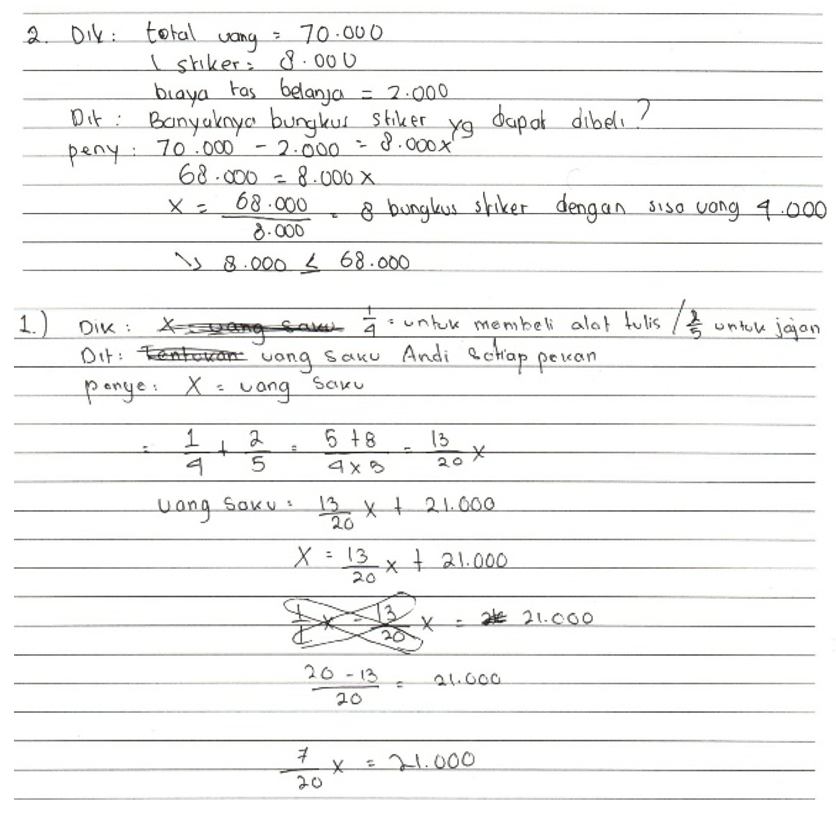
Low mathematical literacy among Indonesian students indicates that students still experience difficulties in understanding contextual information, representing it in mathematical models, and determining appropriate solution strategies. These difficulties may result in different patterns of errors and may be associated with students’ self-efficacy. This study aimed to describe students’ errors in solving mathematical literacy problems in algebra based on the Newman Procedure and self-efficacy. The study employed a descriptive qualitative approach involving eighth-grade students at SMP Negeri 1 Makassar during the 2025/2026 academic year. Six students were purposively selected, with two students representing each self-efficacy category: high, moderate, and low. Data were obtained through a self-efficacy questionnaire, a diagnostic mathematical literacy test, and semi-structured interviews. The questionnaire was used to determine the students’ self-efficacy categories, after which the selected participants completed the diagnostic test and were interviewed to explore their problem-solving processes. Data were analyzed through data condensation, data display, and conclusion drawing. The findings revealed different patterns of errors across self-efficacy levels. Students with high self-efficacy were able to read and comprehend the problems well but still made errors in the transformation, process skills, and final answer encoding stages. Students with moderate self-efficacy made errors across all Newman stages, particularly in interpreting symbols and information, constructing mathematical models, and carrying out calculations. Meanwhile, students with low self-efficacy demonstrated more complex and continuous error patterns, beginning at the reading stage and affecting subsequent stages of problem solving. These findings indicate that self-efficacy levels are associated with the characteristics and complexity of students’ errors; therefore, error diagnosis should be used to design instructional support that addresses students’ needs at each stage of problem solving.
Downloads
References
Almadani, C. M., & Wulandari, R. (2024). Analisis Kesulitan Siswa Kelas 5 SDN Pucangtelu dalam Menyelesaikan Soal Literasi Matematis. Jurnal Media Akademik (JMA), 2(2), 2808–2827. https://doi.org/10.62281/v2i2.189
Angriani, A. D., Nakesya, K., Amrillah, N. A., Alpiyanti, Imansyah, M. R. T., & Maulana, M. I. (2024). Analisis Kesulitan Siswa dalam Menyelesaikan Soal Literasi Matematika PISA berdasarkan Self-efficacy. Prosiding Diskusi Panel Nasional Pendidikan Matematika, 10, 517–526. https://proceeding.unindra.ac.id/index.php/DPNPMunindra/article/view/7294
Annisa, R., & Kartini, K. (2021). Analisis Kesalahan Siswa Dalam Menyelesaikan Soal Barisan dan Deret Aritmatika Menggunakan Tahapan Kesalahan Newman. Jurnal Cendekia : Jurnal Pendidikan Matematika, 5(1), 542–550. https://doi.org/10.31004/cendekia.v5i1.507
Baihaki, Maknun, L., & Nurmeidina, R. (2022). Self-Efficacy Siswa dalam Pembelajaran Matematika secara Daring di MA Miftahul’ulum Tuyau. EMTEKA: Jurnal Pendidikan Matematika, 3(1), 1–9. https://doi.org/10.24127/emteka.v3i1.1243
Bandura, A. (1997). Self Efficacy: The Exercise of Control. W. H Freeman and Company.
Burhanuddin, Waliana, & Permana, F. A. (2023). Analisis Kesalahan Siswa Dalam Menyelesaikan Soal Himpunan Di SMP. Serambi Konstruktivis, 5(4), 39–47. https://ojs.serambimekkah.ac.id/Konstruktivis/article/download/7928/5495
Clements, M. A. K., & Ellerton, N. F. (1996). The Newman Procedure for Analysing Errors on Written Mathematical Tasks. https://compasstech.com.au/ARNOLD/PAGES/newman.htm
Dokumen SMPN 1 Makassar. (2024). Laporan Hasil Ujian Tengah Semester Kelas VII Semester Ganjil 2024/2025.
Fajriyah, E. (2022). Kemampuan Literasi Numerasi Siswa pada Pembelajaran Matematika di Abad 21. Seminar Nasional Pendidikan, 21, 403–409. https://prosiding.unma.ac.id/index.php/semnasfkip/article/view/824
Fimillatika, R. R., & Haerudin, H. (2023). Analisis Kesalahan Siswa dalam Menyelesaikan Soal Cerita SPLDV Berdasarkan Tahapan Newman. EduMatSains : Jurnal Pendidikan, Matematika Dan Sains, 7(2), 231–243. https://doi.org/10.33541/edumatsains.v7i2.3720
Hatta, N., Supriatna, E., & Septian, M. R. (2021). Gambaran Self Efficacy Siswa Di Mts Nurul Hidayah. FOKUS (Kajian Bimbingan & Konseling Dalam Pendidikan), 4(5), 356. https://doi.org/10.22460/fokus.v4i5.7866
Heryani, R. D., Aprilita, G. A., Jinan, A. Z., Dewi, C., & Baiti, N. F. (2024). Pentingnya Kemampuan Penalaran dalam Meningkatkan Kemampuan Literasi Matematika. Prosiding Diskusi Panel Nasional Pendidikan Matematika, 10, 377–382. https://proceeding.unindra.ac.id/index.php/DPNPMunindra/article/view/7276
Lestari, R. D., & Effendi, K. N. S. (2022). Analisis Kemampuan Literasi Matematis Siswa SMP Pada Materi Bangun Datar. Biormatika : Jurnal Ilmiah Fakultas Keguruan Dan IImu Pendidikan, 8(1), 63–73. https://doi.org/10.35569/biormatika.v8i1.1221
Miles, M. ., Huberman, A. ., & Saldana, J. (2014). Qualitative Data Analysis, A Methods Sourcebook, Edition 3. USA: Sage Publications. Terjemahan Tjetjep Rohindi Rohidi, UI-Press.
Nainggolan, B. V. H., & Listiani, T. (2024). Pentingnya Pemberian Umpan Balik untuk Memperbaiki Kesalahan Siswa dalam Menyelesaikan Soal Matematika. Plusminus: Jurnal Pendidikan Matematika, 4(1), 55–68. https://doi.org/plusminus.v4i1.1460
Ningsih, W. F., Studi, P., Matematika, P., Islam, U., Syarif, S., & Riau, K. (2020). Dampak Efikasi Diri Terhadap Proses & Hasil Belajar Matematika (The Impact Of Self-Efficacy On Mathematics Learning Processes and Outcomes). Journal on Teacher Education, 1, 26–32. https://doi.org/10.31004/jote.v1i2.514
Noutsara, S., Neunjhem, T., & Chemrutsame, W. (2021). Mistakes in Mathematics Problems Solving Based on Newman’s Error Analysis on Set Materials. Journal La Edusci, 2(1), 20–27. https://doi.org/10.37899/journallaedusci.v2i1.367
Nurfalah, I. A., Novtiar, C., & Rohaeti, E. E. (2021). Analisis Kesalahan Siswa Berdasarkan Kategori Newman dalam Menyelesaikan Soal Materi Fungsi. JPMI: Jurnal Pembelajaran Matematika Inovatif, 4(1), 205–214. https://doi.org/10.22460/jpmi.v4i1.205-214
Nurtiana, N., & Adirakasiwi, A. G. (2022). Kemampuan Literasi Numerasi Ditinjau Dari Self-Efficacy Literacy Numeracy Skills in terms of Self-Efficacy. Prosiding Seminar Nasional Matematika Dan Pendidikan Matematika (Sesiomadika), 518–532. http://conference.unsika.ac.id/index.php/sesiomadika/Sesiomadika2022
OECD. (2023). PISA 2022 Results (Volume I). OECD. https://doi.org/10.1787/53f23881-en
Oktavira, S., Firmansyah, D., Karawang, U. S., Ronggo Waluyo, J. H., Timur, T., Karawang, J., & Barat, I. (2021). Analisis Kesalahan Siswa dalam Menyelesaikan Soal Cerita Materi Bentuk Aljabrar. Jurnal Pembelajaran Matematika Inovatif, 4(5). https://doi.org/10.22460/jpmi.v4i5.1307-1318
Peltier, C., & Peltier, T. K. (2020). Mining Instruction From Student Mistakes: Conducting an Error Analysis for Mathematical Problem Solving. Beyond Behavior, 1–11. https://doi.org/10.1177/1074295620903050
Puspitaningati, N. P., Pramesthi, S. R. P. W., & Antonius, R. (2024). Analisis Kesalahan Siswa dalam Menyelesaikan Soal Matematika Ditinjau dari Self Efficacy. Journal of Education and Research (JEDARR), 3(1), 26–36. https://doi.org/10.56707/jedarr.v3i1.187
Putri, A. E., Manurung, E. P. F., Wini, S. I., & Fazriah, Z. A. (2024). Pengaruh Efikasi Diri terhadap Kemampuan Pemecahan Masalah Matematika. Jurnal Media Akademik (JMA), 2(12), 1–16. https://doi.org/10.62281
Putri, B. A., Utomo, D. P., & Zukhrufurrohmah. (2021). Analisis Kemampuan Literasi Numerasi Peserta Didik SMP dalam Menyelesaikan Soal Cerita Aljabar. JRPM (Jurnal Review Pembelajaran Matematika), 6(2), 141–153. https://doi.org/10.15642/jrpm.2021.6.2.141-153
Ramadhani, S., Ellianti, & Zubaidah, T. (2023). Kemampuan Literasi Matematika Siswa ditinjau dari Multiple Intelligences di MTsN 1 Banda Aceh. Jurnal Ilmiah Mahasiswa Pendidikan Matematika, 8(1), 71–86. https://jim.unindra.ac.id/index.php/himpunan/article/view/11375
Salsabilah, A. P., & Kurniasih, M. D. (2022). Analisis Kemampuan Literasi Numerasi Ditinjau dari Efikasi Diri pada Peserta Didik SMP. Edumatica: Jurnal Pendidikan Matematika, 12(2), 138–149. https://online-journal.unja.ac.id/edumatica/article/view/18429/14115
Sarah, Y. D., Ariawan, R., Nufus, H., & Rezeki, S. (2023). Kesalahan Siswa dalam Menyelesaikan Soal Higher Order Thinking Skills ditinjau dari Self Efficacy. Suska Journal of Mathematics Education, 9(1), 71–82. https://doi.org/10.24014/sjme.v9i1.18838
Usman, U., Amaludin, R., Rohmiati, R., Risnajayanti, R., Amalia, W. S., Hermanto, H., & Andilah, S. (2024). Deskriptif Kuantitatif Kemampuan Literasi Matematika Siswa SMP di Daerah Pesisir Kota Kendari. Jurnal Cendekia : Jurnal Pendidikan Matematika, 8(3), 2438–2449. https://doi.org/10.31004/cendekia.v8i3.3627
Wahyuni, Y. T., Rufiana, I. S., Faizah, S., & Malang, U. N. (2024). Kesalahan Siswa dalam Menyelesaikan Soal Asesmen Kompetensi Minimum (AKM) Bangun Datar Berdasarkan Teori Kesalahan Newman. ELSE ( Elementary School Education Journal), 8(2), 461–471. https://doi.org/10.30651/else.v8i2.23453
White, A. L. (2010). Numeracy , Literacy and Newman’s Error Analysis. Journal of Science and Methematics Education in Southeast Asia, 33(2), 129–148. https://researchers.westernsydney.edu.au/en/publications/numeracy-literacy-and-newmans-error-analysis/
Wulanningtyas, M. E., & Ate, H. M. (2020). Pengaruh Efikasi diri Siswa terhadap Prestasi Belajar Matematika. Prosiding Konferensi Pendidikan Nasional: Strategi Dan Implementasi Pendidikan Karakter Pada Era Revolusi Industri 4.0, 2(1). https://ejurnal.mercubuana-yogya.ac.id/index.php/Prosiding_KoPeN/article/view/1095
Downloads
Published
How to Cite
Issue
Section
License
Copyright (c) 2026 This is an open-access under the CC-BY-SA license

This work is licensed under a Creative Commons Attribution-ShareAlike 4.0 International License.
Education and Talent Development Center of Indonesia (ETDC Indonesia)
e-mail: kognitif@gmail.com, website : https://etdc-indonesia.com

Kognitif: Jurnal Riset HOTS Pendidikan Matematika dengan Situs: https://etdci.org/journal/kognitif berlisensi Creative Commons Attribution-ShareAlike 4.0 International License






.png)