Analysis of Students’ Readiness to Prepare Research Reports in Research Methodology Courses

https://doi.org/10.51574/kognitif.v6i1.4599
Keywords:
Student Readiness, Research Reports , Research Methodology , Higher EducationAbstract
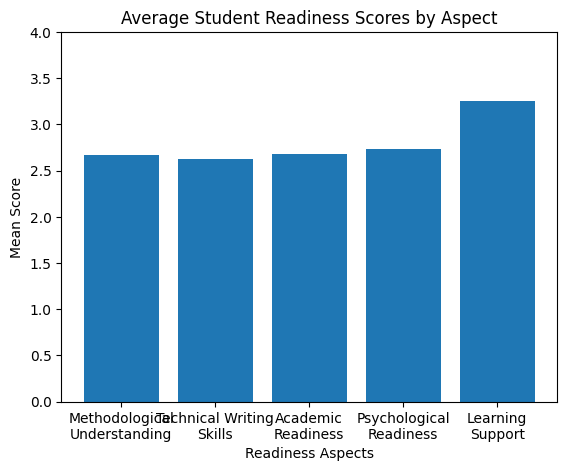
Students’ ability to prepare research reports is an important academic competence that must be developed as part of scientific literacy in higher education. A research report not only serves as the final product of learning in a research methodology course, but also reflects students’ readiness to understand research concepts, apply methodological procedures, and communicate research findings in a systematic and academically acceptable manner. In practice, students’ readiness to prepare research reports varies, even after they have completed a Research Methodology course. This study aimed to describe students’ readiness to prepare research reports in a Research Methodology course in terms of five aspects: methodological understanding, technical writing skills, academic readiness, psychological readiness, and learning support. This study employed a descriptive quantitative design involving 35 fifth-semester students in the Mathematics Education program. Data were collected using a four-point Likert-scale questionnaire consisting of 21 items, distributed online via Google Forms. Data were analyzed descriptively by calculating mean scores and categorizing students’ readiness levels. The results showed that, overall, students’ readiness was at a moderate level across all measured aspects. Learning support obtained the highest mean score, whereas technical skills for preparing research reports received the lowest. These findings indicate that strong learning support is not yet fully matched by students’ internal readiness. Therefore, this study recommends strengthening Research Methodology instruction by placing greater emphasis on research report writing practice, staged exercises, and continuous feedback.
Downloads
References
Adolat, D. (2024). Development and implementation of the teaching methodology of the higher mathematics course based on practice. International Journal of Pedagogics, 4(10). https://doi.org/10.37547/ijp/volume04issue10-12
Batiao, C. A., Yazon, A. D., Manaig, K. A., Sapin, S. B., & Tamban, V. E. (2023). Enhancing Readiness and Mathematics Performance in Face-to-Face Learning Among Grade 7 Students: A Descriptive-Correlational Study. Applied Quantitative Analysis, 3(1). https://doi.org/10.31098/quant.1598
Belawati, T., Daryono, D., Sugilar, S., & Kusmawan, U. (2023). Development of an instrument to assess independent online learning readiness of high school students in Indonesia. Asian Association of Open Universities Journal, 18(1). https://doi.org/10.1108/AAOUJ-09-2022-0139
Dagdag, J. D., & Calimag, N. A. (2023). Scale development and investigation of self-directed learning readiness in Mathematics among Filipino college students. Journal of Research, Policy & Practice of Teachers & Teacher Education, 13(1). https://doi.org/10.37134/jrpptte.vol13.1.5.2023
Dello Iacono, U., Pierri, A., & Taranto, E. (2024). Peer Review Methodology in a Blended Course for Mathematics Teacher Education. International Journal for Technology in Mathematics Education, 26(2). https://doi.org/10.1564/tme_v26.2.01
Evin Gencel, I., & Saracaloğlu, A. S. (2018). The Effect of Layered Curriculum on Reflective Thinking and on Self-Directed Learning Readiness of Prospective Teachers. International Journal of Progressive Education, 14(1), 8–20. https://doi.org/10.29329/ijpe.2018.129.2
Hamidy, A., Maula, I., & Lam, K.-F. T. (2023). The influence of online learning readiness on mathematics achievement with mathematics self-efficacy as an intervening variable. Al-Jabar : Jurnal Pendidikan Matematika, 14(2). https://doi.org/10.24042/ajpm.v14i2.17929
Hoang, N. T. (2020). A model of organizing activities for training metacognitive skills for primary education students in Mathematics teaching methodology courses. Vietnam Journal of Education, 4(1). https://doi.org/10.52296/vje.2020.6
Inganah, S., Rizki, N., Choirudin, C., Farooq, S. M. Y., & Susanti, N. (2023). Integration of Islamic Values, Mathematics, and Career Readiness Competencies of Prospective Teachers in Islamic Universities. Delta-Phi: Jurnal Pendidikan Matematika, 1(1). https://doi.org/10.61650/dpjpm.v1i1.31
Miguel, D. F., Sevil-Serrano, J., Penãrrubia-Lozano, C., & Abós, Á. (2020). Effect of the methodological combination based on flipped classroom and peer instruction on the grades of Physical Activity and Sport Sciences university students. Retos, (41). https://doi.org/10.47197/RETOS.V0I41.83984
Milenković, A., & Stevanić, J. (2025). Integrating Cooperative Learning in Distance Education for Methodology of Teaching Mathematics Course. Pedagogika-Pedagogy, 97(2). https://doi.org/10.53656/ped2025-2.06
Morgan, C. (2020). Writing in the Mathematics Classroom. Writing Mathematically, 32–46. https://doi.org/10.4324/9780203017715-6
Shandy, A. N. (2024). Student Readiness in Mathematics in The New School Year 2024-2025. Journal of Social Sciences and Cultural Study, 1(2). https://doi.org/10.61857/jsscs.v1i2.52
Talib, S. A., Nasri, N. M., & Mahmud, M. S. (2025a). Experts teachers’ point of view on mathematics teachers’ readiness in becoming professional teachers. Journal of Education and Learning, 19(2). https://doi.org/10.11591/edulearn.v19i2.21857
Talib, S. A., Nasri, N. M., & Mahmud, M. S. (2025b). The readiness of mathematics teachers as agents of change: a recent comprehensive review. International Journal of Evaluation and Research in Education, 14(2). https://doi.org/10.11591/ijere.v14i2.30291
Turan, M. B., & Koç, K. (2018). The impact of self-directed learning readiness on critical thinking and self-efficacy among the students of the school of physical education and sports. International Journal of Higher Education, 7(6). https://doi.org/10.5430/ijhe.v7n6p98
Wang, Z., Utemov, V. V., Krivonozhkina, E. G., Liu, G., & Galushkin, A. A. (2018). Pedagogical readiness of mathematics teachers to implement innovative forms of educational activities. Eurasia Journal of Mathematics, Science and Technology Education, 14(1). https://doi.org/10.12973/ejmste/80613
Zulnaidi, H., Mafarja, N., & Oktavika, E. (2024). The readiness of IR4.0: Morality and technology integration among mathematics teachers. STEM Education, 4(1). https://doi.org/10.3934/steme.2024001
Zulnaidi, H., Mafarja, N., Rahim, S. S. A., & Salleh, U. K. M. (2024). Ethical mediation: The influence of mathematics teachers cooperation on readiness for the industrial revolution era in Indonesia and Malaysia. Acta Psychologica, 243. https://doi.org/10.1016/j.actpsy.2024.104151
Downloads
Published
How to Cite
Issue
Section
License
Copyright (c) 2026 Netti Kariani Mendrofa, Ratna Natalia Mendrofa

This work is licensed under a Creative Commons Attribution-ShareAlike 4.0 International License.
Education and Talent Development Center of Indonesia (ETDC Indonesia)
e-mail: kognitif@gmail.com, website : https://etdc-indonesia.com

Kognitif: Jurnal Riset HOTS Pendidikan Matematika dengan Situs: https://etdci.org/journal/kognitif berlisensi Creative Commons Attribution-ShareAlike 4.0 International License






.png)